शुरू हो जाओ

Looking to start an online business without keeping stock? Learn how to start a dropshipping business in India that can earn you good money from home. With India's ecommerce market expected to reach USD 350 billion by 2030, now is the perfect time to start your zero-inventory business.
To start dropshipping in India in 2025, you need:
With platforms like Wcommerce, you can start dropshipping without investment.
Dropshipping is a retail business model where you sell products online without keeping any stock. When customers buy from your online store, the supplier ships products directly to them. Recent studies show that 41% of Indian consumers now prefer online shopping, making ecommerce dropshipping an attractive business option.
Essential requirements to start:
The dropshipping business model in India offers many benefits for passive income:
Want to start an online business without investment? First, select products that:
Popular categories in online retail:
Look for platforms like Wcommerce that offer:
Choose from:
Remember to:
Best promotion channels:
Recent market research indicates:
Recent data shows promising growth in Indian ecommerce:
Begin your journey with:
Basic needs:
The Indian ecommerce space is growing rapidly, making it the perfect time to start your dropshipping business. With thousands of successful online store owners already earning good income, you too can build a profitable business.
Remember:
Yes, dropshipping is completely legal in India. You need basic business registrations like PAN and GST (if turnover exceeds ₹20 lakhs annually).
You can start dropshipping for free using platforms like Wcommerce. Optional costs include marketing (₹5000-10000/month) and business registration (₹1500-2000).
GST registration is mandatory if your annual turnover exceeds ₹20 lakhs. However, registering early helps build trust and allows pan-India business.
Top performing categories include:
Most dropshippers start seeing profits within 3-6 months with proper marketing. Successful dropshipping stores can earn ₹30,000-1,00,000 monthly.
Yes, dropshipping can be managed part-time. Many successful store owners start as a side business while keeping their regular jobs.
Want to start your dropshipping business without investment? Create your free Wcommerce store today!
Getting your first few orders feels exciting. But for most small businesses, the real challenge starts after that. Orders come once, then disappear. Every new month feels like starting from zero again. This is where a WhatsApp community becomes extremely useful for Indian sellers. Not as a place to push offers, but as a space to build familiarity, trust, and repeat buying over time.
This guide is written for small business owners, home sellers, shop owners, and online sellers in tier 2 and tier 3 cities who want steady monthly orders without ads or complicated tools.
A WhatsApp community is a structured space where customers stay connected with your business even after they have purchased once.
Instead of chasing customers again and again, you create one place where:
The WhatsApp communities feature allows you to manage this in an organised way, without running multiple confusing groups.

WhatsApp is already part of daily Indian life. People use it for family groups, school messages, office work, housing societies, and local shops.
According to datareportal 2025, WhatsApp continues to be the most used messaging app in India across cities and towns. This matters because customers do not need to download anything new or learn a new app to stay connected with your business.
For a small seller, this makes WhatsApp the easiest channel to stay remembered.
Do not start by adding everyone.
Start by deciding clearly:
Example:
If you sell women’s kurtis, your community is for women who have already bought once or shown serious interest.
If you run a home bakery, your community is for repeat customers and festival buyers.
Clarity here avoids noise later.
Create one WhatsApp community with:
Name it clearly and respectfully.
Example names:
Avoid names like “best offers” or “discount group”. They reduce trust.
Start small. Even 15 to 30 people are enough.
Add:
Always inform them before adding. A simple message like:
“we share updates and early info here, would you like to join?”
Permission builds trust.
Many sellers fail here by posting only offers.
A healthy WhatsApp community includes:
Example:
If you sell skincare, share how to use it properly.
If you sell clothing, share fabric care tips.
If you sell food, share storage or reheating tips.
This keeps the group useful, not irritating.
For most Indian customers:
Daily messages feel overwhelming and lead to muting.
Consistency matters more than frequency. Customers should feel you are present, not chasing them.
This is the most important missing step for most sellers.
Start local. Do not think digital first.
Ways that actually work in India:
Place a small poster near your counter or packing area:
“join our WhatsApp community for updates and early access”
Create a simple WhatsApp join link and convert it into a qr code.
Paste it on:
When delivering an order, ask politely:
“can i add you to our WhatsApp community for updates?”
Once 10–15 people join, growth becomes natural. Satisfied customers forward the link themselves. In tier 2 and tier 3 cities, word of mouth works better than ads even in 2026.
Monthly buying happens when customers feel comfortable returning.
You can encourage this by:
These actions build emotional connection, not pressure.
Avoid these mistakes:
Once trust breaks, people leave silently.
For most small sellers, the journey looks like this:
Each step has its role. The WhatsApp community is about care, not chasing.
Do not expect instant monthly sales.
In the first month, engagement increases.
In the second or third month, repeat orders start.
This slow but stable growth is healthier than running discounts every week.
A WhatsApp community is not built in one day. It grows through patience, respect, and consistency.
If you want loyal customers who buy every month, focus on building a calm, useful WhatsApp community instead of pushing offers. Start small, grow locally, and let trust do the work.
That is how Indian small businesses build steady income in 2026.
Getting views on reels feels good. Notifications start coming in, likes increase, and a few people even send messages. But many new sellers get stuck at this exact stage. Views are there, DMs are coming, yet orders are not getting confirmed.
This gap between interest and purchase is where most beginners feel confused. They ask the same question again and again: people are messaging me, but how do i convert these Instagram DMs conversations into real orders?
This guide is written for new ecommerce sellers who have already started posting reels and are now receiving DMs. It focuses on what really matters at this stage: talking properly, building trust, and fulfilling the order in a way that makes the customer feel confident.
Instagram DMs is where real selling begins. A reel may bring attention, but the DMs is where the decision happens. In simple terms, Instagram DMs is the private space where a customer feels comfortable asking questions. This is where doubts about price, quality, delivery, and trust come out.
Messaging has quietly become the most common way people talk to businesses online. Meta shared in 2023 that users and businesses exchange over 600 million messages every day across its apps. At the same time, DataReportal reported that global social media usage reached around 5.66 billion user identities by late 2025. For a small seller, this simply means customers are already comfortable sending messages instead of calling or filling forms. If you handle Instagram DMs replies properly, it becomes a direct and free way to reach real customers without spending on ads.
Instagram DMs conversion means turning a conversation into a confirmed order. It does not mean forcing a sale or pushing offers. It means guiding a person from curiosity to confidence.
For beginners, converting DMs into orders depends on three things:
Many sellers lose orders because of small reply mistakes. When someone sends a DMs after watching your reel, they are already interested. Your reply should feel human, not rushed or copied.
A good first reply should:
Example: “Thanks for your message, Priya — this tee is cotton, size m available. Total is ₹499 including basic packing. Would you like me to reserve one in m for you?” This small, friendly framing reduces doubt and moves the conversation forward.
At this stage, manual DMs selling for beginners is better than automation. You do not need tools or auto replies for your first orders. What you need is attention. Replying on time shows seriousness. Using the customer’s name shows respect. Answering patiently shows reliability. Many top blogs discuss automation for scaling, but automation works only when volume is high. For your first 10–50 orders, personal replies convert better than smart systems.
Trust is the biggest reason people buy from small sellers.
You can build trust in Instagram DMs by doing simple things:
Trust grows when customers feel you are not hiding anything. Small actions like giving a tracking number, sending a dispatch photo, or telling them exactly when the courier will arrive make a big difference.
The Instagram DMs selling process should feel smooth, not stressful.
Once a customer shows interest, move towards order confirmation clearly:
This step reduces cancellations and complaints. A clear short message like: “Confirming your order: red tee, size m, ₹499 total. Payment by upi or cash on delivery? Dispatch in 2 days, delivery in 5–7 days” keeps things simple and professional.
Not every DMs converts immediately. Some people read and disappear.
Instagram DMs follow up is important, but it should be gentle.
A good follow up cadence:
Example follow up: “Hi Rahul, checking if you need any help with the size. I can send a quick size chart or hold one unit until tomorrow.” This keeps the tone helpful, not pushy.
Small gestures create big impact in early orders.
Personalised selling on Instagram can be as simple as:
These actions make customers feel valued. Many first-time buyers become repeat buyers because of the experience, not because of discounts.

Some mistakes silently kill conversions.
Common Instagram DMs mistakes include:
Being aware of these helps you avoid them and keep the sale on track.
Since these are the first few orders, replying to every Instagram DMs manually and on time is more important than using tools or automation. A simple, polite conversation, clear pricing, and honest delivery timelines convert better than smart tricks. Small actions like confirming details properly, packing carefully, and adding a handwritten note or name card help new sellers build strong early trust.
Use short, natural messages. Edit the words so they sound like you.
These scripts keep the conversation human and clear.
In tier 2 and tier 3 cities, people still value conversation and reassurance. Customers often compare online sellers to local shopkeepers they trust. When you reply patiently and deliver what you promise, you stand out. This is also a form of free marketing. Happy customers talk, share, and recommend. This helps you get customers without ads — real practical free marketing for your small business.
Once a customer places their first order through Instagram DMs, the next step is keeping them close. This is where building a WhatsApp community for repeat customers helps small sellers turn one-time buyers into regular monthly orders.
Instagram DMs is not just a messaging feature. It is the most important selling space for new online businesses. If you want to convert reel views into confirmed orders, focus on how you talk, how you explain, and how you deliver. Manual replies, honest communication, and small personal touches build trust faster than any tool.
Your next two actions: 1) open your DMs, now and set a simple reply routine — respond within a few hours, and 2) prepare a small packing kit with a thank you note to include with the next order. These little steps will increase the chance that a DMs becomes a happy customer.
Starting an online store feels exciting in the beginning. You register your domain, upload products, create a whatsapp business catalog, connect meta suite, and tell a few friends about it. For the first few days, everything feels new.
Then comes the silence.
No views.
No messages.
No orders.
Most new sellers immediately assume something is wrong with their product or pricing. Some feel social media is overcrowded. Others think online selling only works for big brands In reality, the problem is usually much simpler. There is no clear content strategy. This article is written for regular people, not marketers or agencies. If you are a new online seller from a tier 2 or tier 3 city and want your first real views and inquiries without spending money, this 7-day content strategy will help you move forward with confidence.
A content strategy is simply a planned way of deciding what to post, when to post, and why to post. For beginners, a content strategy is not about analytics, funnels, or complex planning. It is about removing confusion. When you wake up knowing what you need to post that day, half the stress disappears. According to a 2023 hubspot report, businesses that plan their content in advance are more consistent and see better engagement compared to those who post randomly. For a new seller, consistency builds visibility and trust faster than perfect content.
This guide is for:
You do not need marketing knowledge, paid tools, or professional equipment to follow this strategy.
Many beginners search for a social media content planner or expensive software. Most of these tools remain unused after a week.
Instead, open google sheets.
Create four columns:
This simple sheet becomes your content plan in google sheets. It works on mobile, laptop, and even cyber cafe computers. This is your marketing content plan. No subscriptions, no learning curve.
.png)
People buy from people, especially in India.
Your first post should introduce:
This can be a simple video or a static post with your photo. Speak normally. Do not try to sound like an advertisement. Imagine you are talking to a customer standing in front of your shop. This post builds familiarity and tells people why they should follow you.
Most new sellers only post product photos. That rarely works. On day 2, focus on a problem your customer already has.
Examples:
This helps people relate emotionally before they think about buying.
Many people stop posting because they do not know what to say on camera. This is where ai tools help. You can use ChatGPT or Gemini to write simple, clear scripts. Below are copy-paste prompts you can use directly.
“write a short instagram reel script in simple Indian english for a new seller explaining what my product is, who it is for, and why it is useful. keep the tone friendly and natural.”
“give me 5 simple talking points for a beginner seller to explain their product in a short video. avoid marketing words.”
“write a short instagram caption in easy english for a product post. keep it honest and relatable.”
After getting the response, read it once and change words that do not sound like you. This is how to create content using ChatGPT without sounding artificial.
You do not need a camera or studio. Stand near a window during daytime. Natural light works well.
Use your phone camera and record short videos:
This is how to make reels at home. Honest videos perform better than over-polished ones.
For editing, use free video editing apps for phone like:
All of these apps work well even on budget smartphones.
Not every day needs a video.
On busy days, create static posts:
You can design these easily using canva. If you do not have good photos, ai tools for product images like gemini can help generate basic visuals. These are especially useful when starting out. Understanding static post vs video post is important. Videos bring reach. Static posts give clarity and details.
Trust grows when people see real activity.
Post things like:
Even small updates show that your business is active and genuine. A 2022 google consumer insights study showed that Indian customers trust businesses more when they see real process or usage content rather than only promotional posts.
Look at your posts from the last six days.
Ask yourself:
Repeat that type of content next week. Many beginners stop after one week because results are slow. In reality, content starts working when platforms see consistency. Once you start getting views and reactions from your content, the next step is how you handle Instagram DM conversion — this determines whether those inquiries turn into real orders.”
Raman is a t-shirt seller from a small city. He recently started selling online. He created a content calendar for instagram using google sheets. He used gemini to generate model-style images because he could not afford a photoshoot. He posted reels and static posts for seven days without skipping. By the end of the week, people started messaging him for prices and sizes. No ads. No influencers. Just steady effort. This is how content strategy works for beginners.
Posting regularly in the beginning helps platforms understand your account, but quality and honesty matter more than frequency.
Yes, if you edit it and make it sound human. Ai should support your thinking, not replace it.
Instagram and whatsapp together work well for new sellers in India.
Plan your posts in a simple google sheet, write scripts using chatgpt or gemini, record videos on your phone, and edit them for free using canva or mobile apps. If you can’t shoot photos, ai tools like gemini can help generate basic product visuals for static posts. This strategy works best when you focus on consistency, not perfection.
A practical content strategy for beginners is not about trends or complicated planning. It is about clarity, routine, and showing up honestly.
If you have just created your online store, your next step is simple. Open google sheets, plan the next seven days, and start posting without waiting for perfection. That is how content strategy brings your first real views and orders in everyday Indian life.
Selling online in India has changed quietly over the years. In 2026, most buying decisions no longer start on big shopping websites. They start inside a WhatsApp chat, an Instagram Reel, or a short video someone watched before going to bed. People now buy from those they already know, follow, or trust.
This shift is what many experienced sellers now call sell social. It is not a new trend anymore. It is a daily habit for small businesses, shop owners, home sellers, and creators across tier 2 and tier 3 cities. Social selling feels familiar, less stressful, and more personal than traditional ecommerce.
This guide explains how social selling using WhatsApp, Instagram, and YouTube Shorts works in 2026. It focuses on real steps, real behaviour, and real problems sellers face, not theory or jargon.
Sell social simply means selling products through social platforms where conversations already happen. Instead of forcing customers to visit a separate website, you share product links, explain benefits, answer doubts, and take orders through chats and short videos.
In 2026, people are more careful with money. They avoid impulse buying and trust recommendations from real people more than ads. This is why WhatsApp selling for small business has grown steadily.
According to Statista, India crossed 600 million WhatsApp users in 2025. For sellers, this means customers are already present on the platform. The job is no longer about attracting traffic. It is about handling trust properly.
.png)
WhatsApp feels personal. Messages arrive next to family chats and daily updates. Because of this, selling on WhatsApp works only when it feels respectful and clear.
A WhatsApp Business account shows customers that you are serious. It allows you to display:
These details reduce confusion and hesitation. Many order cancellations happen simply because customers feel unsure or ignored.
Keep your greeting message short and human. In 2026, people immediately recognise copied or robotic replies.
Meta Business Suite often scares new sellers because it sounds technical. In reality, it is only a control panel.
It helps you:
Selling does not happen inside Meta Business Suite. Conversations do. Think of this setup as preparing the ground so selling feels smooth later.
Take time to verify your business properly. Rushed setups often create problems when orders increase.
A catalog is simply a digital list of products with photos, prices, and short descriptions.
A meta catalog is created inside Meta Business Suite. It allows your products to appear across Instagram and connect with WhatsApp.
A WhatsApp catalog is what customers browse directly inside a chat when they tap “view catalog”.
When both catalogs are connected, updates become easier. You change product details once, and they reflect everywhere. Many sellers prefer systems like Wcommerce because they can share direct product links on social media channels without worrying about technical work, stock, or delivery.
In practice, sellers follow a simple flow. First, a business account is created inside Meta Business Suite and linked with the Instagram profile. After that, a basic product catalog is added with clear names, prices, and short descriptions.
Once the meta catalog is ready, it is connected to the WhatsApp Business account so the same products appear inside chats as a WhatsApp catalog. At this stage, sellers do not need a large product list. Even a small, well explained catalog is enough to begin.
The goal of catalog setup is not perfection. It is clarity. A clean catalog makes browsing easy and reduces unnecessary questions.
Instagram Reels remain powerful in 2026, but selling styles have matured. Loud promotions and fake urgency no longer work. People scroll past them.
What works today is relatability:
A Reel does not need fancy editing or studio lighting. A phone, natural light, and honesty are enough. Instagram selling works best when Reels feel like friendly explanations, not advertisements.
According to Statista, India had over 350 million Instagram users in 2024, and short video consumption continues to rise. For small sellers, this means organic reach is still possible if content feels real.
YouTube Shorts has become especially important in non metro India. Many people may not follow you on Instagram, but they still watch YouTube daily.
A practical approach in 2026 is reuse. The same short video posted as an Instagram Reel can also be shared as a YouTube Short with a slightly adjusted caption.
Do not aim for viral success. Aim for familiarity. Shorts work best when they repeatedly answer small, everyday doubts.
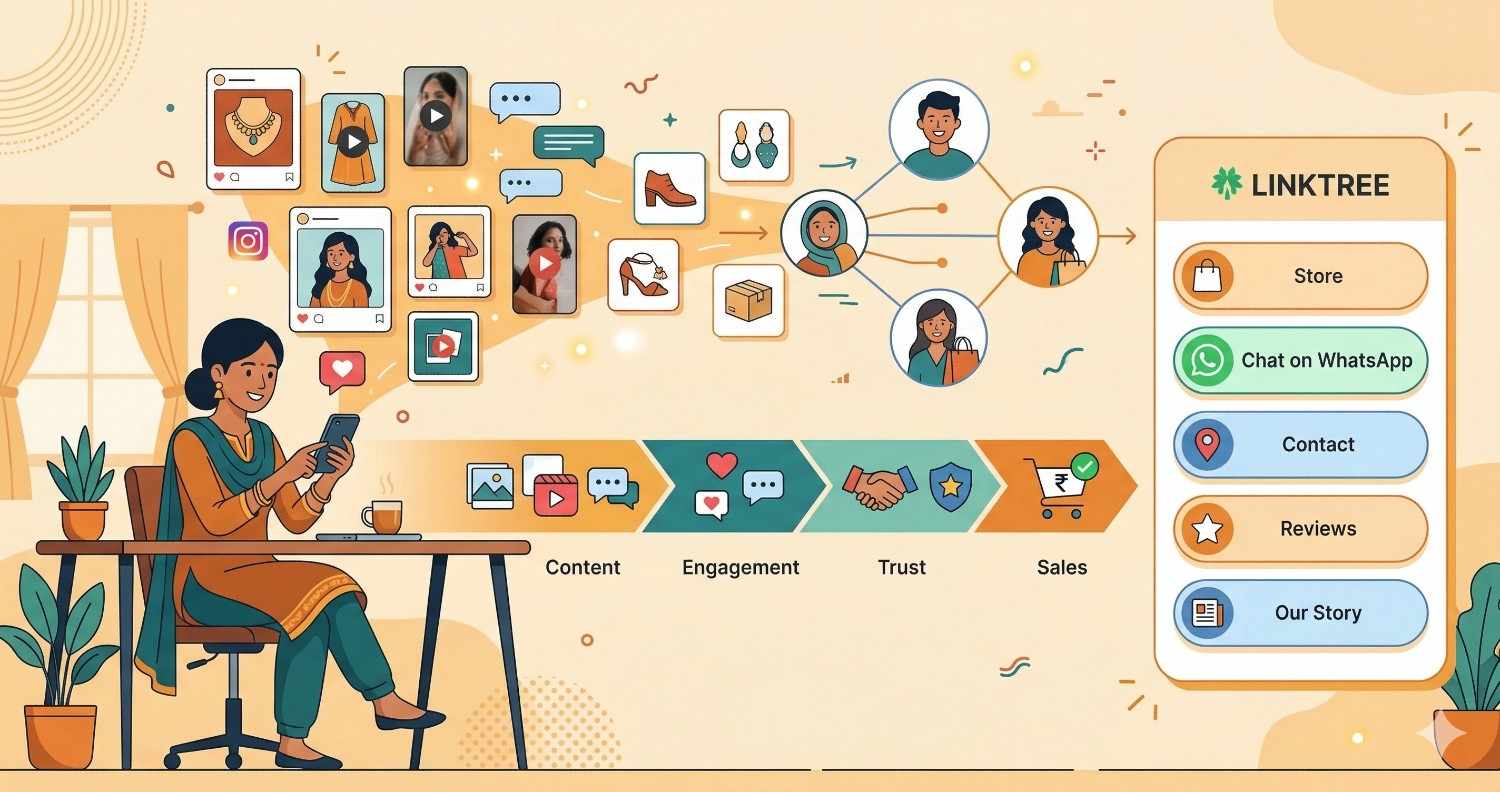
The strongest sellers do not treat platforms separately. They use them as a flow.
A common pattern looks like this:
This flow feels natural because it matches how people already communicate with friends and local businesses.
Once your WhatsApp Business profile, catalog, and social profiles are in place, many sellers feel unsure about the next step. They know the tools, but not the rhythm.
Posting randomly often leads to frustration. Consistency matters more than creativity at the start. For new sellers, having a simple posting rhythm often helps more than overthinking content, which is why a 7-day content strategy for new sellers to get their first views & inquiries can make the early phase feel more manageable.
WhatsApp communities have become more structured and useful than old style groups. A community allows you to share updates without disturbing personal chats.
Use communities to:
Avoid daily promotions. One useful update per week builds trust faster than constant selling.
Orders usually come through:
When an order comes in, slow down. Confirm details clearly. Explain delivery timelines honestly. In 2026, transparency matters more than speed.
.png)
Many sellers focus only on closing the sale. But most cancellations happen after the sale, not before it.
A simple follow up message that confirms:
can help reduce order cancellations and returns. Follow ups are not extra work. They protect your time, effort, and reputation.
Sell social works because it fits naturally into everyday routines. People check WhatsApp between chores. They watch Reels during short breaks. They scroll YouTube Shorts before sleeping.
You are not asking customers to change habits. You are meeting them where they already are. This is why social selling using WhatsApp and Instagram feels more sustainable than traditional ecommerce for small businesses.
Sell social in 2026 is not about being present everywhere. It is about using WhatsApp, Instagram, and YouTube in a way that feels human, clear, and manageable. Focus on a clean setup, honest communication, and steady follow ups.
When selling feels like a conversation instead of a campaign, WhatsApp selling and Instagram selling stop feeling stressful and start fitting naturally into daily life. For small businesses across India, that shift makes all the difference.
In 2026, setting up an online store is no longer a big or scary decision. People from tier 2 and tier 3 cities are selling online from their homes, kirana stores, college hostels, and small rented rooms. What has changed is not ambition, but access. Tools are simpler, costs are clearer, and you no longer need technical skills to begin.
This guide explains online store setup in a clear, practical way. It does not push any single platform. Instead, it helps you understand all realistic options, step-by-step, with real costs, tools, and decisions you will actually face.
Before you start, pause and answer one simple question.
Do you want to sell on a large ecommerce platform, or do you want to create your own online store?
Selling on ecommerce platforms gives you ready traffic and structure. Creating your own ecommerce store gives you control over branding, pricing, and customer relationships. Many first-time sellers start on one route and later move to the other. Both paths are valid.
This step shapes everything else.
Start with products that are
Common starting categories for first-time sellers include clothing, accessories, grocery items, beauty products, health and wellness, and pet supplies. Avoid launching with too many products. A focused catalogue builds trust faster.
Platforms such as a Shopify website allow you to create a professional online store with product pages, order management, and payments. You usually need to select a plan, choose a theme, and manage listings.
If you want full ownership, you can buy a domain, choose hosting, and build your website using tools like website builders or content management systems. This gives flexibility but needs more effort.
Both options work. The right choice depends on time, budget, and comfort level.
A domain is your store’s address on the internet, like yourstore.in.
Approximate costs
Many ecommerce platforms include hosting, which reduces technical work for beginners.
Product listing is where customers decide whether to trust you.
Each product should include
You do not need expensive photo shoots. Many sellers now use ai tools to write descriptions and improve images. Tools like ChatGPT or Gemini help create simple product text, while ai image tools help clean backgrounds or adjust lighting. Always keep visuals realistic.
Branding does not mean fancy boxes.
Start with
Ai tools can help design logos and labels quickly. You can improve packaging slowly as your store grows.
Payment convenience is critical for Indian buyers.
Most customers prefer
Payment gateways like Razorpay are commonly used.
Razorpay cost overview:
If you sell a product worth ₹1000, the payment fee is roughly ₹20 to ₹30. You only pay when you receive money, which makes it beginner friendly.
Optional costs may include paid themes or apps. This option suits sellers who are comfortable with a fixed monthly cost.
This route is cheaper over time but requires more effort for maintenance and updates.
Before sharing your store link
This builds confidence and avoids mistakes.
This is one of the most common doubts among first-time sellers.
Traditional ecommerce stores usually need products, packaging, and shipping. However, newer models allow sellers to create a free online store without holding inventory.
Some tools let you start by simply adding your phone number and store name. Products are available from a ready catalogue, packaging and shipping are handled, and you sell using a store link or qr code.
Platforms like Wcommerce follow this approach. They offer a growing range of products across fashion, accessories, grocery, health and wellness, beauty, and pet categories. Many sellers use this model to learn selling without upfront investment.
According to India Brand Equity Foundation reports, India’s ecommerce market has grown steadily due to mobile access and digital payments. For small sellers, this means opportunity, but only if trust is built.
Focus on
In tier 2 and tier 3 cities, word of mouth still matters as much as technology.

Online store setup in 2026 is no longer about technical skills or big investments. It is about choosing a path that fits your time, budget, and confidence level. Some sellers start with ecommerce platforms, some build their own stores, and others begin with inventory-free tools to understand how online selling works in real life.
What matters most is not perfection, but clarity. Knowing your costs, understanding how payments and delivery work, and replying honestly to customers builds trust faster than any feature or design.
Once your store basics are in place, many first-time sellers naturally move towards social selling methods, where WhatsApp, Instagram, and short videos help bring real conversations and inquiries. In India, especially in tier 2 and tier 3 cities, selling grows when people trust the seller, feel supported, and confidently recommend the store to others.
For a beginner, the hardest part is not coming up with a business idea. It is knowing whether that idea will work before you spend money. This blog will help you understand simple ways to test your business idea before you invest money, so you avoid loss in online business and start safely.
Testing your business idea means using small and simple experiments to check if real people are interested in what you want to sell. It does not mean building a full business or buying stock worth thousands of rupees. It means starting small, checking demand, and learning what people actually want.
Imagine someone has an idea, but does not know whether customers will buy it or not. Testing helps answer that question before spending a lot.
Let us take a simple real life example from a small town in India.
Reena is a housewife. She makes very tasty homemade mango and lemon pickles that everyone in her neighbourhood loves. Friends often told her, “You should sell these online.” But Reena was afraid. What if no one outside her town bought? What if she lost money?
So instead of jumping in, she decided to test her idea.
Meena asked herself one honest question. Are people outside my circle willing to buy homemade pickles online?
She was not trying to become a big brand. Her goal was only to check demand before starting.
Instead of hiring a developer, she used free templates available on website builders and created a one page website at no cost. The page was very simple and easy to understand. It explained:
She clearly listed one product to avoid confusion.
Homemade mango pickle, 500 grams, priced at 299 rupees.
To make the website look real and trustworthy, she bought a basic domain name: picklesbyreena.in, which cost her around 150 rupees per month for the first year. This was her only fixed cost. She did not buy hosting plans or paid tools. The domain was used only to test demand, not to build a full business.
This step helped her understand how online business ideas from home actually work in real life, without spending much money.
Meena added a buy now button on the page. But instead of taking payment, the button led to a simple message saying, sorry, out of stock. we will be in stock soon.
This was intentional. She was not selling yet. She was only testing interest.
The purpose of this button was to check how many visitors actually wanted to buy.
Meena used her phone to record short videos showing:
She shared these videos on social media. To speed up testing, she spent 50 to 100 rupees per day on simple ads for a few days. She kept the budget low and stopped once she saw enough activity. This was not marketing. This was testing.
This is a small budget business start that many beginners can manage.
Now comes an important concept.
Out of 100 people who visited her page, more than 5 clicked the buy now button. This means her click through rate, or ctr, was above 5 percent.
In simple terms, ctr tells you how many people showed buying interest after seeing your page. A higher ctr means stronger demand.
For Meena, this was enough proof. People were not just watching. They were trying to buy.
This is how she checked demand before starting, without investing heavily.
Not everyone wants to use paid ads right away. Here are free ways to check demand:
These help you see real interest without spending any money.
If you use paid tests, do it in a controlled way:
This is not real selling yet. This is checking demand before starting an online business.
When you test before investing money, you learn:
This approach becomes part of your beginner online business guide.
Many people go wrong by:
Testing helps you avoid these mistakes and plan safely.
In 2026, online business ideas are growing in India fast, and competition is rising. Many people in tier 2 and tier 3 cities are now shopping online as part of daily life. This means products that solve real needs, show value, and reach the right audience are more likely to succeed.
Instead of spending big money or building everything at once, testing your idea first helps you start with confidence and avoid loss. When you see real interest, then you are ready for the next step — how to set up your first online store step-by-step (no technical skills needed).
Testing your business idea before you invest money helps you start online the smart way. Simple steps like creating a low cost domain, sharing honest videos, running small ad tests, and measuring click through rates show whether people are truly interested. For anyone with an online business idea in 2026, doing small tests first can make the difference between loss and success.
Do not rush. Test small, learn from real interest, and then build your business with clarity.
Statista internet usage India report 2025
Shopify editorial insights 2026
Inc42 ecommerce trends 2026
Create your store with Wcommerce today and enjoy a zero subscription fee forever. Don't miss this exclusive opportunity to maximize your earnings without any monthly costs.