How to set up my online store step-by-step in 2026
Subham Kumar
-
February 3, 2026
-
Online store setup in 2026: a practical guide for first-time sellers
In 2026, setting up an online store is no longer a big or scary decision. People from tier 2 and tier 3 cities are selling online from their homes, kirana stores, college hostels, and small rented rooms. What has changed is not ambition, but access. Tools are simpler, costs are clearer, and you no longer need technical skills to begin.
This guide explains online store setup in a clear, practical way. It does not push any single platform. Instead, it helps you understand all realistic options, step-by-step, with real costs, tools, and decisions you will actually face.
First decision where do you want to sell
Before you start, pause and answer one simple question.
Do you want to sell on a large ecommerce platform, or do you want to create your own online store?
Selling on ecommerce platforms gives you ready traffic and structure. Creating your own ecommerce store gives you control over branding, pricing, and customer relationships. Many first-time sellers start on one route and later move to the other. Both paths are valid.
Step 1: Decide what you want to sell
This step shapes everything else.
Start with products that are
easy to explain
easy to ship
familiar to you
Common starting categories for first-time sellers include clothing, accessories, grocery items, beauty products, health and wellness, and pet supplies. Avoid launching with too many products. A focused catalogue builds trust faster.
Step 2: Choose your selling route
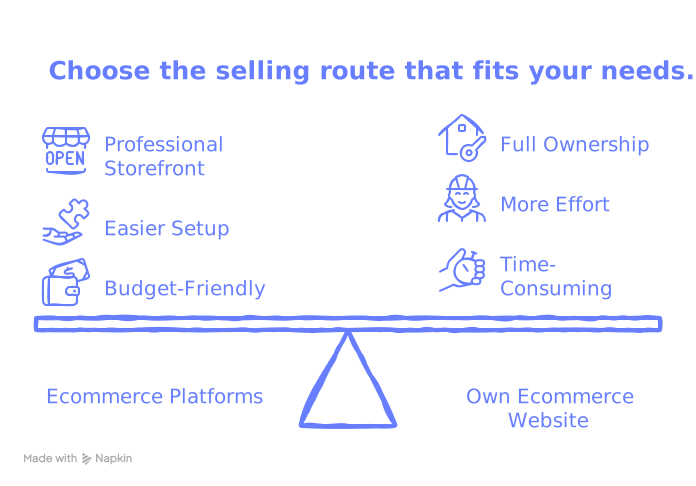
Selling through ecommerce platforms
Platforms such as a Shopify website allow you to create a professional online store with product pages, order management, and payments. You usually need to select a plan, choose a theme, and manage listings.
Creating your own ecommerce website
If you want full ownership, you can buy a domain, choose hosting, and build your website using tools like website builders or content management systems. This gives flexibility but needs more effort.
Both options work. The right choice depends on time, budget, and comfort level.
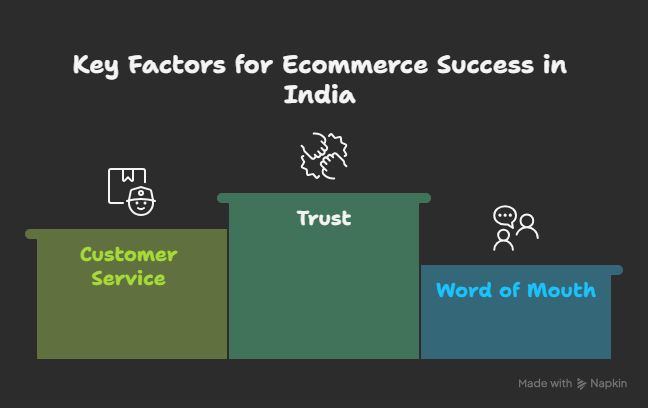
What truly drives ecommerce success in India: strong customer service, built-in trust, and word of mouth that travels faster than ads.
Step 3: Buy a domain and set up your website
A domain is your store’s address on the internet, like yourstore.in.
Approximate costs
domain name: ₹700 to ₹1200 per year
hosting or website builder: ₹3000 to ₹6000 per year
Many ecommerce platforms include hosting, which reduces technical work for beginners.
Step 4: List your products properly
Product listing is where customers decide whether to trust you.
Each product should include
clear product name
simple, honest description
correct pricing
good quality images
You do not need expensive photo shoots. Many sellers now use ai tools to write descriptions and improve images. Tools like ChatGPT or Gemini help create simple product text, while ai image tools help clean backgrounds or adjust lighting. Always keep visuals realistic.
Step 5: Branding and packaging basics
Branding does not mean fancy boxes.
Start with
a simple logo
clean packaging
printed label with store name and contact
Ai tools can help design logos and labels quickly. You can improve packaging slowly as your store grows.
Step 6: Set up payments and upi
Payment convenience is critical for Indian buyers.
Most customers prefer
upi
debit or credit cards
cash on delivery
Payment gateways like Razorpay are commonly used.
Razorpay cost overview:
no setup fee for basic accounts
around 2% to 3% per successful transaction
gst applicable on transaction fees
If you sell a product worth ₹1000, the payment fee is roughly ₹20 to ₹30. You only pay when you receive money, which makes it beginner friendly.
Step 7: Understand platform and website costs
Cost of creating a Shopify website
basic plan: around ₹2000 to ₹3000 per month
domain name: ₹700 to ₹1200 per year
transaction charges apply separately
Optional costs may include paid themes or apps. This option suits sellers who are comfortable with a fixed monthly cost.
Cost of building your own ecommerce website
domain: ₹700 to ₹1200 per year
hosting: ₹3000 to ₹6000 per year
ecommerce tools or plugins: free to paid options
This route is cheaper over time but requires more effort for maintenance and updates.
Step 8: Test everything before launch
Before sharing your store link
place a test order
check payment flow
review product details
This builds confidence and avoids mistakes.
Big question is creating an online store free possible without products
This is one of the most common doubts among first-time sellers.
Traditional ecommerce stores usually need products, packaging, and shipping. However, newer models allow sellers to create a free online store without holding inventory.
Some tools let you start by simply adding your phone number and store name. Products are available from a ready catalogue, packaging and shipping are handled, and you sell using a store link or qr code.
Platforms like Wcommerce follow this approach. They offer a growing range of products across fashion, accessories, grocery, health and wellness, beauty, and pet categories. Many sellers use this model to learn selling without upfront investment.
What matters more than the tools
According to India Brand Equity Foundation reports, India’s ecommerce market has grown steadily due to mobile access and digital payments. For small sellers, this means opportunity, but only if trust is built.
Focus on
replying to customers on time
being honest about delivery
improving listings slowly
In tier 2 and tier 3 cities, word of mouth still matters as much as technology.
In India, ecommerce grows when people trust the seller, feel supported, and recommend the store to others.
Conclusion
Online store setup in 2026 is no longer about technical skills or big investments. It is about choosing a path that fits your time, budget, and confidence level. Some sellers start with ecommerce platforms, some build their own stores, and others begin with inventory-free tools to understand how online selling works in real life.
What matters most is not perfection, but clarity. Knowing your costs, understanding how payments and delivery work, and replying honestly to customers builds trust faster than any feature or design.
Once your store basics are in place, many first-time sellers naturally move towards social selling methods, where WhatsApp, Instagram, and short videos help bring real conversations and inquiries. In India, especially in tier 2 and tier 3 cities, selling grows when people trust the seller, feel supported, and confidently recommend the store to others.
How to set up my online store step-by-step in 2026
Subham Kumar
-
February 3, 2026
-
Online store setup in 2026: a practical guide for first-time sellers
In 2026, setting up an online store is no longer a big or scary decision. People from tier 2 and tier 3 cities are selling online from their homes, kirana stores, college hostels, and small rented rooms. What has changed is not ambition, but access. Tools are simpler, costs are clearer, and you no longer need technical skills to begin.
This guide explains online store setup in a clear, practical way. It does not push any single platform. Instead, it helps you understand all realistic options, step-by-step, with real costs, tools, and decisions you will actually face.
First decision where do you want to sell
Before you start, pause and answer one simple question.
Do you want to sell on a large ecommerce platform, or do you want to create your own online store?
Selling on ecommerce platforms gives you ready traffic and structure. Creating your own ecommerce store gives you control over branding, pricing, and customer relationships. Many first-time sellers start on one route and later move to the other. Both paths are valid.
Step 1: Decide what you want to sell
This step shapes everything else.
Start with products that are
easy to explain
easy to ship
familiar to you
Common starting categories for first-time sellers include clothing, accessories, grocery items, beauty products, health and wellness, and pet supplies. Avoid launching with too many products. A focused catalogue builds trust faster.
Step 2: Choose your selling route
Selling through ecommerce platforms
Platforms such as a Shopify website allow you to create a professional online store with product pages, order management, and payments. You usually need to select a plan, choose a theme, and manage listings.
Creating your own ecommerce website
If you want full ownership, you can buy a domain, choose hosting, and build your website using tools like website builders or content management systems. This gives flexibility but needs more effort.
Both options work. The right choice depends on time, budget, and comfort level.
What truly drives ecommerce success in India: strong customer service, built-in trust, and word of mouth that travels faster than ads.
Step 3: Buy a domain and set up your website
A domain is your store’s address on the internet, like yourstore.in.
Approximate costs
domain name: ₹700 to ₹1200 per year
hosting or website builder: ₹3000 to ₹6000 per year
Many ecommerce platforms include hosting, which reduces technical work for beginners.
Step 4: List your products properly
Product listing is where customers decide whether to trust you.
Each product should include
clear product name
simple, honest description
correct pricing
good quality images
You do not need expensive photo shoots. Many sellers now use ai tools to write descriptions and improve images. Tools like ChatGPT or Gemini help create simple product text, while ai image tools help clean backgrounds or adjust lighting. Always keep visuals realistic.
Step 5: Branding and packaging basics
Branding does not mean fancy boxes.
Start with
a simple logo
clean packaging
printed label with store name and contact
Ai tools can help design logos and labels quickly. You can improve packaging slowly as your store grows.
Step 6: Set up payments and upi
Payment convenience is critical for Indian buyers.
Most customers prefer
upi
debit or credit cards
cash on delivery
Payment gateways like Razorpay are commonly used.
Razorpay cost overview:
no setup fee for basic accounts
around 2% to 3% per successful transaction
gst applicable on transaction fees
If you sell a product worth ₹1000, the payment fee is roughly ₹20 to ₹30. You only pay when you receive money, which makes it beginner friendly.
Step 7: Understand platform and website costs
Cost of creating a Shopify website
basic plan: around ₹2000 to ₹3000 per month
domain name: ₹700 to ₹1200 per year
transaction charges apply separately
Optional costs may include paid themes or apps. This option suits sellers who are comfortable with a fixed monthly cost.
Cost of building your own ecommerce website
domain: ₹700 to ₹1200 per year
hosting: ₹3000 to ₹6000 per year
ecommerce tools or plugins: free to paid options
This route is cheaper over time but requires more effort for maintenance and updates.
Step 8: Test everything before launch
Before sharing your store link
place a test order
check payment flow
review product details
This builds confidence and avoids mistakes.
Big question is creating an online store free possible without products
This is one of the most common doubts among first-time sellers.
Traditional ecommerce stores usually need products, packaging, and shipping. However, newer models allow sellers to create a free online store without holding inventory.
Some tools let you start by simply adding your phone number and store name. Products are available from a ready catalogue, packaging and shipping are handled, and you sell using a store link or qr code.
Platforms like Wcommerce follow this approach. They offer a growing range of products across fashion, accessories, grocery, health and wellness, beauty, and pet categories. Many sellers use this model to learn selling without upfront investment.
What matters more than the tools
According to India Brand Equity Foundation reports, India’s ecommerce market has grown steadily due to mobile access and digital payments. For small sellers, this means opportunity, but only if trust is built.
Focus on
replying to customers on time
being honest about delivery
improving listings slowly
In tier 2 and tier 3 cities, word of mouth still matters as much as technology.
In India, ecommerce grows when people trust the seller, feel supported, and recommend the store to others.
Conclusion
Online store setup in 2026 is no longer about technical skills or big investments. It is about choosing a path that fits your time, budget, and confidence level. Some sellers start with ecommerce platforms, some build their own stores, and others begin with inventory-free tools to understand how online selling works in real life.
What matters most is not perfection, but clarity. Knowing your costs, understanding how payments and delivery work, and replying honestly to customers builds trust faster than any feature or design.
Once your store basics are in place, many first-time sellers naturally move towards social selling methods, where WhatsApp, Instagram, and short videos help bring real conversations and inquiries. In India, especially in tier 2 and tier 3 cities, selling grows when people trust the seller, feel supported, and confidently recommend the store to others.
References
India Brand Equity Foundation
Nasscom digital commerce reports
Shopify small business resources
Salesforce ecommerce insights
5
min read
A realistic scene of a first-time seller in India viewing an online store on his phone, highlighting a clear add to cart button and an order confirmed alert.
Online store setup in 2026: a practical guide for first-time sellers
In 2026, setting up an online store is no longer a big or scary decision. People from tier 2 and tier 3 cities are selling online from their homes, kirana stores, college hostels, and small rented rooms. What has changed is not ambition, but access. Tools are simpler, costs are clearer, and you no longer need technical skills to begin.
This guide explains online store setup in a clear, practical way. It does not push any single platform. Instead, it helps you understand all realistic options, step-by-step, with real costs, tools, and decisions you will actually face.
First decision where do you want to sell
Before you start, pause and answer one simple question.
Do you want to sell on a large ecommerce platform, or do you want to create your own online store?
Selling on ecommerce platforms gives you ready traffic and structure. Creating your own ecommerce store gives you control over branding, pricing, and customer relationships. Many first-time sellers start on one route and later move to the other. Both paths are valid.
Step 1: Decide what you want to sell
This step shapes everything else.
Start with products that are
easy to explain
easy to ship
familiar to you
Common starting categories for first-time sellers include clothing, accessories, grocery items, beauty products, health and wellness, and pet supplies. Avoid launching with too many products. A focused catalogue builds trust faster.
Step 2: Choose your selling route
Selling through ecommerce platforms
Platforms such as a Shopify website allow you to create a professional online store with product pages, order management, and payments. You usually need to select a plan, choose a theme, and manage listings.
Creating your own ecommerce website
If you want full ownership, you can buy a domain, choose hosting, and build your website using tools like website builders or content management systems. This gives flexibility but needs more effort.
Both options work. The right choice depends on time, budget, and comfort level.
What truly drives ecommerce success in India: strong customer service, built-in trust, and word of mouth that travels faster than ads.
Step 3: Buy a domain and set up your website
A domain is your store’s address on the internet, like yourstore.in.
Approximate costs
domain name: ₹700 to ₹1200 per year
hosting or website builder: ₹3000 to ₹6000 per year
Many ecommerce platforms include hosting, which reduces technical work for beginners.
Step 4: List your products properly
Product listing is where customers decide whether to trust you.
Each product should include
clear product name
simple, honest description
correct pricing
good quality images
You do not need expensive photo shoots. Many sellers now use ai tools to write descriptions and improve images. Tools like ChatGPT or Gemini help create simple product text, while ai image tools help clean backgrounds or adjust lighting. Always keep visuals realistic.
Step 5: Branding and packaging basics
Branding does not mean fancy boxes.
Start with
a simple logo
clean packaging
printed label with store name and contact
Ai tools can help design logos and labels quickly. You can improve packaging slowly as your store grows.
Step 6: Set up payments and upi
Payment convenience is critical for Indian buyers.
Most customers prefer
upi
debit or credit cards
cash on delivery
Payment gateways like Razorpay are commonly used.
Razorpay cost overview:
no setup fee for basic accounts
around 2% to 3% per successful transaction
gst applicable on transaction fees
If you sell a product worth ₹1000, the payment fee is roughly ₹20 to ₹30. You only pay when you receive money, which makes it beginner friendly.
Step 7: Understand platform and website costs
Cost of creating a Shopify website
basic plan: around ₹2000 to ₹3000 per month
domain name: ₹700 to ₹1200 per year
transaction charges apply separately
Optional costs may include paid themes or apps. This option suits sellers who are comfortable with a fixed monthly cost.
Cost of building your own ecommerce website
domain: ₹700 to ₹1200 per year
hosting: ₹3000 to ₹6000 per year
ecommerce tools or plugins: free to paid options
This route is cheaper over time but requires more effort for maintenance and updates.
Step 8: Test everything before launch
Before sharing your store link
place a test order
check payment flow
review product details
This builds confidence and avoids mistakes.
Big question is creating an online store free possible without products
This is one of the most common doubts among first-time sellers.
Traditional ecommerce stores usually need products, packaging, and shipping. However, newer models allow sellers to create a free online store without holding inventory.
Some tools let you start by simply adding your phone number and store name. Products are available from a ready catalogue, packaging and shipping are handled, and you sell using a store link or qr code.
Platforms like Wcommerce follow this approach. They offer a growing range of products across fashion, accessories, grocery, health and wellness, beauty, and pet categories. Many sellers use this model to learn selling without upfront investment.
What matters more than the tools
According to India Brand Equity Foundation reports, India’s ecommerce market has grown steadily due to mobile access and digital payments. For small sellers, this means opportunity, but only if trust is built.
Focus on
replying to customers on time
being honest about delivery
improving listings slowly
In tier 2 and tier 3 cities, word of mouth still matters as much as technology.
In India, ecommerce grows when people trust the seller, feel supported, and recommend the store to others.
Conclusion
Online store setup in 2026 is no longer about technical skills or big investments. It is about choosing a path that fits your time, budget, and confidence level. Some sellers start with ecommerce platforms, some build their own stores, and others begin with inventory-free tools to understand how online selling works in real life.
What matters most is not perfection, but clarity. Knowing your costs, understanding how payments and delivery work, and replying honestly to customers builds trust faster than any feature or design.
Once your store basics are in place, many first-time sellers naturally move towards social selling methods, where WhatsApp, Instagram, and short videos help bring real conversations and inquiries. In India, especially in tier 2 and tier 3 cities, selling grows when people trust the seller, feel supported, and confidently recommend the store to others.
References
India Brand Equity Foundation
Nasscom digital commerce reports
Shopify small business resources
Salesforce ecommerce insights
Share Now
Subham Kumar
Hey! I’m Subham from the Founder’s Office at Wcommerce. My work revolves around research, product strategy, and making store management easier for everyone. I love turning ideas into practical tools that store owners can actually use.
Getting a product idea is exciting. But spending money on the wrong idea can be painful. Before investing, smart founders validate their ideas first. Here is a simple step-by-step guide to test whether your product will actually sell.
Heading 1
Heading 2
Heading 3
Heading 4
Heading 5
Heading 6
Lorem ipsum dolor sit amet, consectetur adipiscing elit, sed do eiusmod tempor incididunt ut labore et dolore magna aliqua. Ut enim ad minim veniam, quis nostrud exercitation ullamco laboris nisi ut aliquip ex ea commodo consequat. Duis aute irure dolor in reprehenderit in voluptate velit esse cillum dolore eu fugiat nulla pariatur.
Starting an online store is exciting, but choosing the right product is the real challenge. Before investing money, smart sellers study demand, competitors, and customer behaviour. This guide explains simple methods of market analysis that anyone in India can use in 2026.
Heading 1
Heading 2
Heading 3
Heading 4
Heading 5
Heading 6
Lorem ipsum dolor sit amet, consectetur adipiscing elit, sed do eiusmod tempor incididunt ut labore et dolore magna aliqua. Ut enim ad minim veniam, quis nostrud exercitation ullamco laboris nisi ut aliquip ex ea commodo consequat. Duis aute irure dolor in reprehenderit in voluptate velit esse cillum dolore eu fugiat nulla pariatur.
Thinking of launching a product but unsure if it will sell? Stop guessing and start validating. Here’s how small Indian sellers can use Google Trends and real customer discussions to make smarter e-commerce decisions in 2026.
Heading 1
Heading 2
Heading 3
Heading 4
Heading 5
Heading 6
Lorem ipsum dolor sit amet, consectetur adipiscing elit, sed do eiusmod tempor incididunt ut labore et dolore magna aliqua. Ut enim ad minim veniam, quis nostrud exercitation ullamco laboris nisi ut aliquip ex ea commodo consequat. Duis aute irure dolor in reprehenderit in voluptate velit esse cillum dolore eu fugiat nulla pariatur.


.jpg)
.png)


.png)