How to run profitable Facebook and Instagram ads in 2026 (simple guide for small sellers)
Subham Kumar
-
March 27, 2026
-
Stop wasting money on ads: how to run Facebook and Instagram ads that actually convert (2026 guide)
If you have ever tried running ads on Facebook or Instagram, chances are you have felt confused, frustrated, or even disappointed.
You spend a few hundred rupees, boost a post, and wait for orders. Nothing happens. After a few attempts, it starts to feel like ads only work for big brands with large budgets.
But that is not true.
The real issue is not the platform. It is the approach.
For small sellers in India, especially those in tier 2 and tier 3 cities, ads can work extremely well when done in a simple and structured way. The goal is not to become an expert overnight. The goal is to understand the basics clearly and avoid common mistakes.
In this guide, we will break down Facebook and Instagram ads in a practical way so that you can confidently run your first campaign and improve it step by step.
What are Facebook and Instagram ads?
Facebook and Instagram ads, also known as Meta ads, are paid promotions that allow you to show your products to specific people based on their interests, location, and online behavior.
Instead of waiting for customers to find you, ads help you reach people who are more likely to be interested in what you are selling.
Simple definition
Facebook and Instagram ads are paid posts that help your product reach the right audience and bring potential customers directly to you.
According to Buffer (2026), these platforms allow businesses to target users very precisely and track performance in real time, which is why they are widely used by both small sellers and large brands.
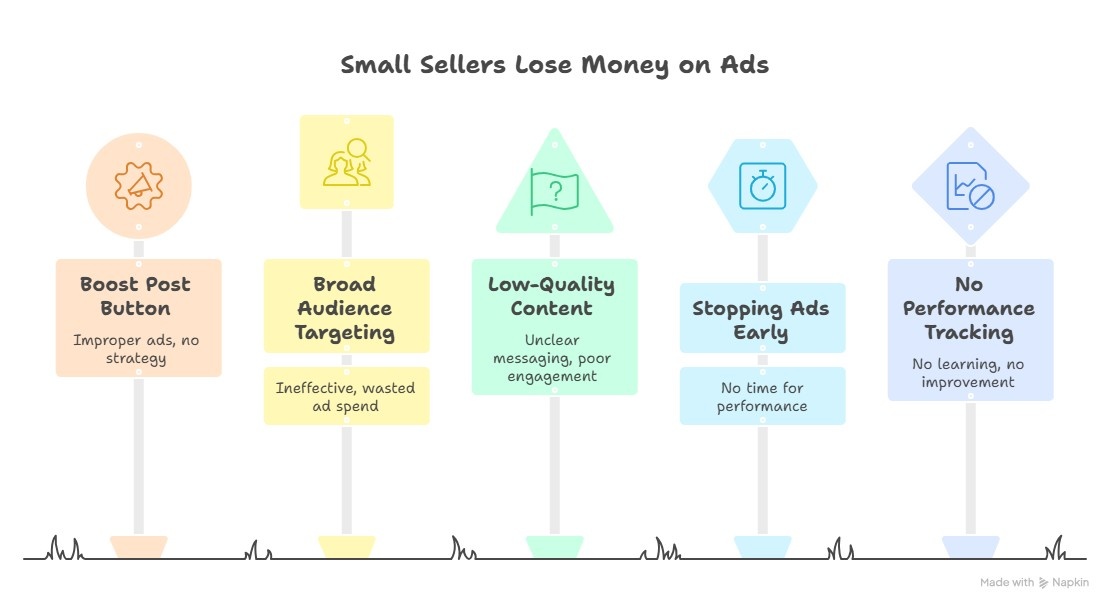
Why most small sellers lose money on ads
Before learning how to run ads, it is important to understand why they fail.
Many small sellers:
use the “boost post” button instead of proper ads
target a very broad audience
use low-quality images or unclear messaging
stop ads too early
do not track performance
This creates a situation where money is spent without learning anything.
Research-based guides, including those from Forbes Advisor (2025), highlight that lack of strategy and testing is one of the main reasons small businesses fail in digital advertising.
Understanding the goal of your ad
Every ad must have a clear purpose. Without that, even a well-designed ad will not perform well.
You generally have three common goals:
getting messages
driving traffic to a website
generating direct sales
For most small sellers, especially those without a website, the most practical starting point is messages.
This means your ad encourages people to start a conversation with you on WhatsApp or Instagram.
Why this works well in India:
customers prefer asking questions before buying
it builds trust
it reduces fake or uncertain orders
Setting up your ad account
To run ads properly, you need access to Meta Ads Manager. This is the platform where all serious advertising happens.
You will need:
a Facebook page
an Instagram account
access to Ads Manager
Once this is set up, you can create campaigns, control budgets, and track results in one place.
While the interface may look complex at first, most of the important work happens in just a few key sections.
Creating your first ad campaign
When you open Ads Manager and click on “Create,” you will be asked to choose an objective.
For beginners, selecting messages is the most practical choice. This allows your ad to directly bring interested customers into a conversation.
After choosing the objective, the campaign moves into three levels:
campaign
ad set
ad
Each level has a specific purpose.
Understanding audience selection
This is one of the most misunderstood parts of advertising.
Many beginners try to select too many interests or make the audience too narrow. Others select everyone, thinking it will increase reach.
In reality, simple targeting works best.
For most small sellers:
location can be your city or all of India
age group can be 18 to 45
gender depends on your product
Modern ad systems already use machine learning to optimize results. According to Coursera (2025) learning material on Facebook marketing, over-complicating targeting can actually reduce performance.
The key is to start simple and let the platform learn.
Budget: how much should you spend?
One of the biggest concerns for small sellers is budget.
You do not need a large investment to begin.
A practical starting point is:
₹300 to ₹500 per day
This is not about immediate profit. This is your testing phase.
During this stage, you are learning:
which creative works
which audience responds
what kind of messages you receive
Think of this as gathering data, not just spending money.
The most important part: your ad creative
If there is one thing that decides success or failure, it is your creative.
Creative includes:
the image or video
the text
the overall message
For Indian audiences, especially in smaller cities, simple and relatable content works best.
High-performing creatives usually:
show the product clearly
include real usage
feel authentic, not overly polished
For example, a video of someone wearing a kurti and explaining its fabric and fit often performs better than a studio-style product image.
Using AI to improve your ads
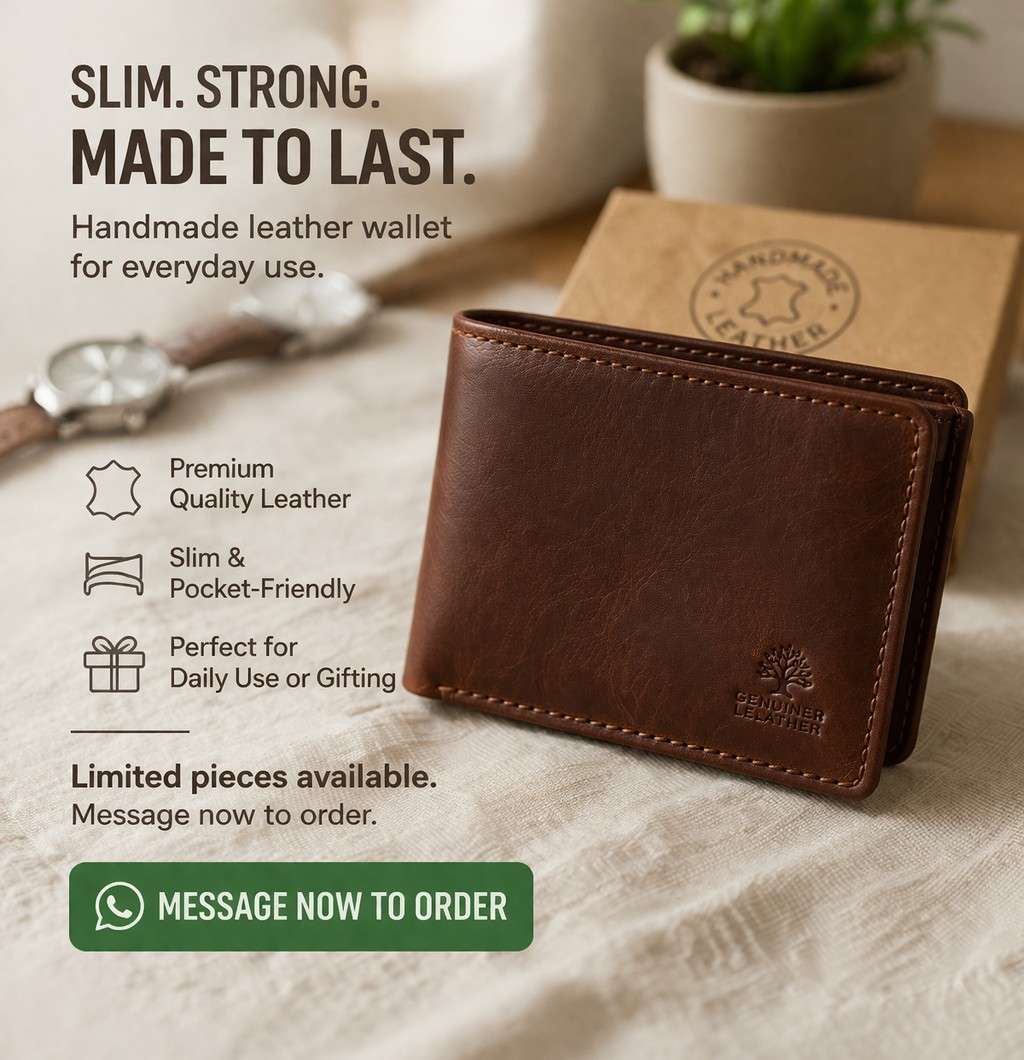
Premium handmade leather wallet displayed on a wooden surface as a product ad for social media marketing
If you are not comfortable with design or writing, AI tools can help simplify the process.
You can upload your product image into a tool like ChatGPT and use a prompt such as:
“Improve this product image for a Facebook ad. Make it look clear, natural, and appealing for Indian customers. Focus on product details and lighting.”
For writing ad text, you can use:
“Write a simple Facebook ad for this product. Keep the language easy for Indian customers. Highlight benefits and add a clear call to action.”
The goal is not to make the ad look artificial. It should still feel real and trustworthy.
What happens after you launch the ad
Once your ad is live, the most common mistake is checking results too quickly.
Ads need time to gather data. Ideally, you should wait at least two to three days before making any changes.
During this time, the system is learning which users are more likely to respond.
Understanding basic metrics
You do not need to track everything. Focus on a few simple indicators.
Click-through rate (CTR) tells you how many people clicked on your ad after seeing it. If this is low, your creative may not be appealing.
Cost per click (CPC) shows how much you are paying for each click. Lower is generally better.
Messages or inquiries indicate actual interest. This is the most important for small sellers.
Return on ad spend (ROAS) tells you whether you are making money compared to what you are spending.
According to multiple digital marketing studies, including those referenced in Forbes Advisor, focusing on a few key metrics is more effective than tracking too many numbers.
The importance of testing
Running one ad and expecting results is not a reliable strategy.
A better approach is to test multiple versions.
For example:
one video showing the product in use
one image with product details
one customer testimonial
You can divide your budget across these versions and observe which performs best.
After a few days, you stop the weaker ads and continue with the stronger one.
This process is how experienced advertisers reduce risk and improve results.
Scaling your ads
Once you start getting consistent responses or sales, you can increase your budget gradually.
Instead of jumping from ₹300 to ₹2000, increase slowly:
₹300 to ₹500
₹500 to ₹800
This allows the system to adjust without losing performance.
Common challenges and how to handle them
Even with the right setup, you may face issues.
Some customers may ask questions but not buy. This is normal. Focus on improving your communication.
You may receive orders but face problems like returns or cancellations. Clear communication and partial advance payments can help reduce this risk.
You may feel overwhelmed managing messages. Keeping a simple record of orders, even in a notebook or basic spreadsheet, can bring clarity.
A realistic example
Consider a small seller selling handmade bags.
They run an ad with a daily budget of ₹300. Over three days, they receive 25 messages. Out of these, 6 customers place orders.
Even with a modest profit per product, the campaign becomes profitable.
More importantly, the seller now understands what kind of creative and audience works.
Conclusion
Running Facebook and Instagram ads is not about spending large amounts of money or understanding every technical detail.
It is about following a simple process:
choosing the right objective
starting with a manageable budget
creating clear and honest creatives
testing different approaches
learning from results
When approached this way, ads become a tool for growth rather than a source of frustration.
For small sellers in India, especially those already using Instagram and WhatsApp, this is one of the most practical ways to reach new customers and build a steady flow of orders.
Frequently asked questions
How much budget is enough to start?
A daily budget of ₹300 to ₹500 is sufficient for testing and learning.
How long should I run ads before judging results?
At least two to three days. Ads need time to optimize.
Do I need a website to run ads?
No. You can use WhatsApp or Instagram messages to handle orders.
Why am I getting clicks but no sales?
This may be due to weak product presentation, unclear pricing, or lack of trust during conversation.
Should I use the boost post button?
It is better to use Ads Manager for more control and better performance.
Can beginners really make ads work?
Yes. With a simple approach and consistent testing, many small sellers successfully use ads to grow their business.
How to run profitable Facebook and Instagram ads in 2026 (simple guide for small sellers)
Subham Kumar
-
March 27, 2026
-
Stop wasting money on ads: how to run Facebook and Instagram ads that actually convert (2026 guide)
If you have ever tried running ads on Facebook or Instagram, chances are you have felt confused, frustrated, or even disappointed.
You spend a few hundred rupees, boost a post, and wait for orders. Nothing happens. After a few attempts, it starts to feel like ads only work for big brands with large budgets.
But that is not true.
The real issue is not the platform. It is the approach.
For small sellers in India, especially those in tier 2 and tier 3 cities, ads can work extremely well when done in a simple and structured way. The goal is not to become an expert overnight. The goal is to understand the basics clearly and avoid common mistakes.
In this guide, we will break down Facebook and Instagram ads in a practical way so that you can confidently run your first campaign and improve it step by step.
What are Facebook and Instagram ads?
Facebook and Instagram ads, also known as Meta ads, are paid promotions that allow you to show your products to specific people based on their interests, location, and online behavior.
Instead of waiting for customers to find you, ads help you reach people who are more likely to be interested in what you are selling.
Simple definition
Facebook and Instagram ads are paid posts that help your product reach the right audience and bring potential customers directly to you.
According to Buffer (2026), these platforms allow businesses to target users very precisely and track performance in real time, which is why they are widely used by both small sellers and large brands.
Why most small sellers lose money on ads
Before learning how to run ads, it is important to understand why they fail.
Many small sellers:
use the “boost post” button instead of proper ads
target a very broad audience
use low-quality images or unclear messaging
stop ads too early
do not track performance
This creates a situation where money is spent without learning anything.
Research-based guides, including those from Forbes Advisor (2025), highlight that lack of strategy and testing is one of the main reasons small businesses fail in digital advertising.
Understanding the goal of your ad
Every ad must have a clear purpose. Without that, even a well-designed ad will not perform well.
You generally have three common goals:
getting messages
driving traffic to a website
generating direct sales
For most small sellers, especially those without a website, the most practical starting point is messages.
This means your ad encourages people to start a conversation with you on WhatsApp or Instagram.
Why this works well in India:
customers prefer asking questions before buying
it builds trust
it reduces fake or uncertain orders
Setting up your ad account
To run ads properly, you need access to Meta Ads Manager. This is the platform where all serious advertising happens.
You will need:
a Facebook page
an Instagram account
access to Ads Manager
Once this is set up, you can create campaigns, control budgets, and track results in one place.
While the interface may look complex at first, most of the important work happens in just a few key sections.
Creating your first ad campaign
When you open Ads Manager and click on “Create,” you will be asked to choose an objective.
For beginners, selecting messages is the most practical choice. This allows your ad to directly bring interested customers into a conversation.
After choosing the objective, the campaign moves into three levels:
campaign
ad set
ad
Each level has a specific purpose.
Understanding audience selection
This is one of the most misunderstood parts of advertising.
Many beginners try to select too many interests or make the audience too narrow. Others select everyone, thinking it will increase reach.
In reality, simple targeting works best.
For most small sellers:
location can be your city or all of India
age group can be 18 to 45
gender depends on your product
Modern ad systems already use machine learning to optimize results. According to Coursera (2025) learning material on Facebook marketing, over-complicating targeting can actually reduce performance.
The key is to start simple and let the platform learn.
Budget: how much should you spend?
One of the biggest concerns for small sellers is budget.
You do not need a large investment to begin.
A practical starting point is:
₹300 to ₹500 per day
This is not about immediate profit. This is your testing phase.
During this stage, you are learning:
which creative works
which audience responds
what kind of messages you receive
Think of this as gathering data, not just spending money.
The most important part: your ad creative
If there is one thing that decides success or failure, it is your creative.
Creative includes:
the image or video
the text
the overall message
For Indian audiences, especially in smaller cities, simple and relatable content works best.
High-performing creatives usually:
show the product clearly
include real usage
feel authentic, not overly polished
For example, a video of someone wearing a kurti and explaining its fabric and fit often performs better than a studio-style product image.
Using AI to improve your ads
Premium handmade leather wallet displayed on a wooden surface as a product ad for social media marketing
If you are not comfortable with design or writing, AI tools can help simplify the process.
You can upload your product image into a tool like ChatGPT and use a prompt such as:
“Improve this product image for a Facebook ad. Make it look clear, natural, and appealing for Indian customers. Focus on product details and lighting.”
For writing ad text, you can use:
“Write a simple Facebook ad for this product. Keep the language easy for Indian customers. Highlight benefits and add a clear call to action.”
The goal is not to make the ad look artificial. It should still feel real and trustworthy.
What happens after you launch the ad
Once your ad is live, the most common mistake is checking results too quickly.
Ads need time to gather data. Ideally, you should wait at least two to three days before making any changes.
During this time, the system is learning which users are more likely to respond.
Understanding basic metrics
You do not need to track everything. Focus on a few simple indicators.
Click-through rate (CTR) tells you how many people clicked on your ad after seeing it. If this is low, your creative may not be appealing.
Cost per click (CPC) shows how much you are paying for each click. Lower is generally better.
Messages or inquiries indicate actual interest. This is the most important for small sellers.
Return on ad spend (ROAS) tells you whether you are making money compared to what you are spending.
According to multiple digital marketing studies, including those referenced in Forbes Advisor, focusing on a few key metrics is more effective than tracking too many numbers.
The importance of testing
Running one ad and expecting results is not a reliable strategy.
A better approach is to test multiple versions.
For example:
one video showing the product in use
one image with product details
one customer testimonial
You can divide your budget across these versions and observe which performs best.
After a few days, you stop the weaker ads and continue with the stronger one.
This process is how experienced advertisers reduce risk and improve results.
Scaling your ads
Once you start getting consistent responses or sales, you can increase your budget gradually.
Instead of jumping from ₹300 to ₹2000, increase slowly:
₹300 to ₹500
₹500 to ₹800
This allows the system to adjust without losing performance.
Common challenges and how to handle them
Even with the right setup, you may face issues.
Some customers may ask questions but not buy. This is normal. Focus on improving your communication.
You may receive orders but face problems like returns or cancellations. Clear communication and partial advance payments can help reduce this risk.
You may feel overwhelmed managing messages. Keeping a simple record of orders, even in a notebook or basic spreadsheet, can bring clarity.
A realistic example
Consider a small seller selling handmade bags.
They run an ad with a daily budget of ₹300. Over three days, they receive 25 messages. Out of these, 6 customers place orders.
Even with a modest profit per product, the campaign becomes profitable.
More importantly, the seller now understands what kind of creative and audience works.
Conclusion
Running Facebook and Instagram ads is not about spending large amounts of money or understanding every technical detail.
It is about following a simple process:
choosing the right objective
starting with a manageable budget
creating clear and honest creatives
testing different approaches
learning from results
When approached this way, ads become a tool for growth rather than a source of frustration.
For small sellers in India, especially those already using Instagram and WhatsApp, this is one of the most practical ways to reach new customers and build a steady flow of orders.
Frequently asked questions
How much budget is enough to start?
A daily budget of ₹300 to ₹500 is sufficient for testing and learning.
How long should I run ads before judging results?
At least two to three days. Ads need time to optimize.
Do I need a website to run ads?
No. You can use WhatsApp or Instagram messages to handle orders.
Why am I getting clicks but no sales?
This may be due to weak product presentation, unclear pricing, or lack of trust during conversation.
Should I use the boost post button?
It is better to use Ads Manager for more control and better performance.
Can beginners really make ads work?
Yes. With a simple approach and consistent testing, many small sellers successfully use ads to grow their business.
References
Buffer
Coursera
Forbes Advisor
Meta Ads Documentation
Metricool
5
min read
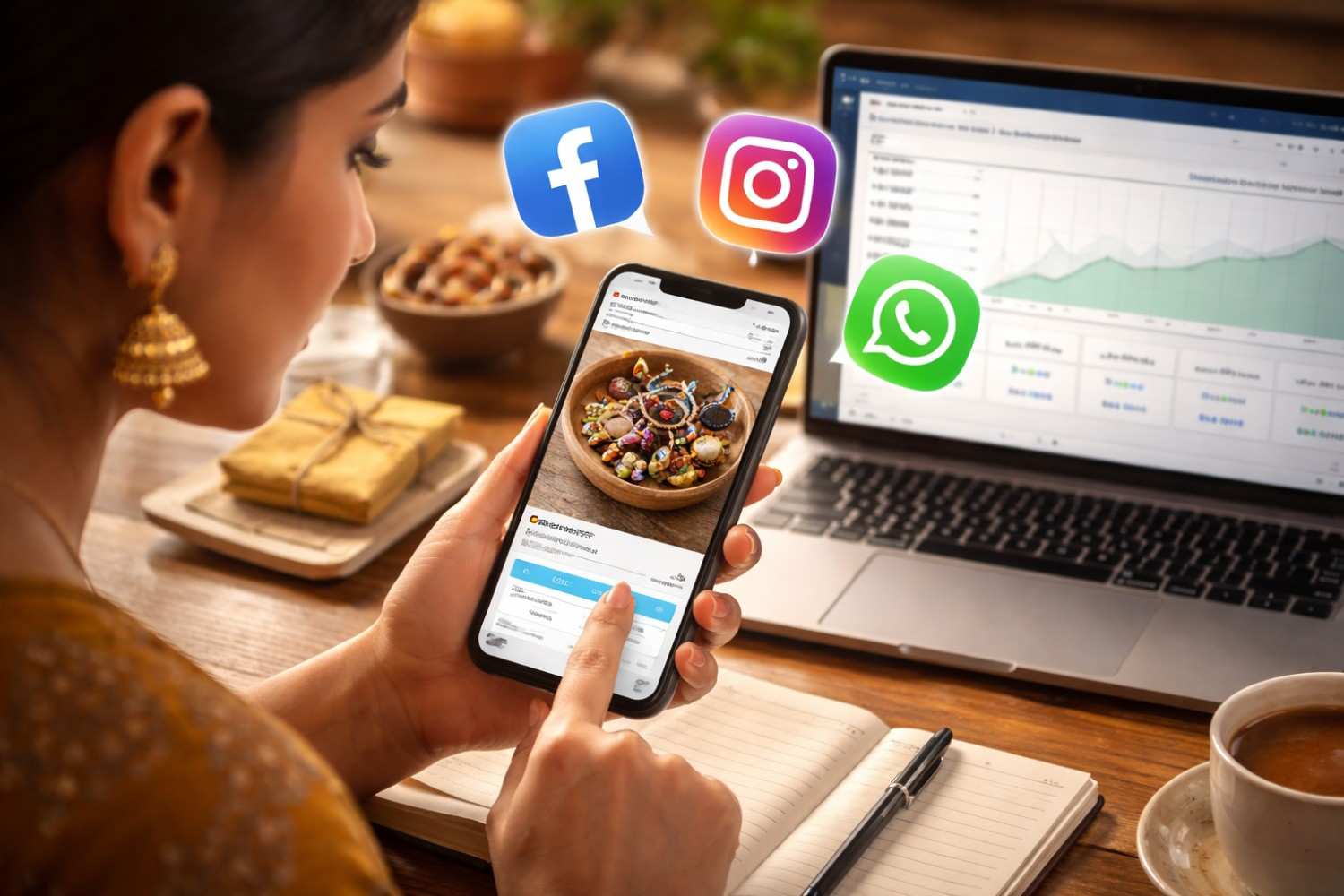
A warm indoor scene showing a small business owner analyzing ad performance on a laptop while viewing product listings on her phone, representing social media advertising
Stop wasting money on ads: how to run Facebook and Instagram ads that actually convert (2026 guide)
If you have ever tried running ads on Facebook or Instagram, chances are you have felt confused, frustrated, or even disappointed.
You spend a few hundred rupees, boost a post, and wait for orders. Nothing happens. After a few attempts, it starts to feel like ads only work for big brands with large budgets.
But that is not true.
The real issue is not the platform. It is the approach.
For small sellers in India, especially those in tier 2 and tier 3 cities, ads can work extremely well when done in a simple and structured way. The goal is not to become an expert overnight. The goal is to understand the basics clearly and avoid common mistakes.
In this guide, we will break down Facebook and Instagram ads in a practical way so that you can confidently run your first campaign and improve it step by step.
What are Facebook and Instagram ads?
Facebook and Instagram ads, also known as Meta ads, are paid promotions that allow you to show your products to specific people based on their interests, location, and online behavior.
Instead of waiting for customers to find you, ads help you reach people who are more likely to be interested in what you are selling.
Simple definition
Facebook and Instagram ads are paid posts that help your product reach the right audience and bring potential customers directly to you.
According to Buffer (2026), these platforms allow businesses to target users very precisely and track performance in real time, which is why they are widely used by both small sellers and large brands.
Why most small sellers lose money on ads
Before learning how to run ads, it is important to understand why they fail.
Many small sellers:
use the “boost post” button instead of proper ads
target a very broad audience
use low-quality images or unclear messaging
stop ads too early
do not track performance
This creates a situation where money is spent without learning anything.
Research-based guides, including those from Forbes Advisor (2025), highlight that lack of strategy and testing is one of the main reasons small businesses fail in digital advertising.
Understanding the goal of your ad
Every ad must have a clear purpose. Without that, even a well-designed ad will not perform well.
You generally have three common goals:
getting messages
driving traffic to a website
generating direct sales
For most small sellers, especially those without a website, the most practical starting point is messages.
This means your ad encourages people to start a conversation with you on WhatsApp or Instagram.
Why this works well in India:
customers prefer asking questions before buying
it builds trust
it reduces fake or uncertain orders
Setting up your ad account
To run ads properly, you need access to Meta Ads Manager. This is the platform where all serious advertising happens.
You will need:
a Facebook page
an Instagram account
access to Ads Manager
Once this is set up, you can create campaigns, control budgets, and track results in one place.
While the interface may look complex at first, most of the important work happens in just a few key sections.
Creating your first ad campaign
When you open Ads Manager and click on “Create,” you will be asked to choose an objective.
For beginners, selecting messages is the most practical choice. This allows your ad to directly bring interested customers into a conversation.
After choosing the objective, the campaign moves into three levels:
campaign
ad set
ad
Each level has a specific purpose.
Understanding audience selection
This is one of the most misunderstood parts of advertising.
Many beginners try to select too many interests or make the audience too narrow. Others select everyone, thinking it will increase reach.
In reality, simple targeting works best.
For most small sellers:
location can be your city or all of India
age group can be 18 to 45
gender depends on your product
Modern ad systems already use machine learning to optimize results. According to Coursera (2025) learning material on Facebook marketing, over-complicating targeting can actually reduce performance.
The key is to start simple and let the platform learn.
Budget: how much should you spend?
One of the biggest concerns for small sellers is budget.
You do not need a large investment to begin.
A practical starting point is:
₹300 to ₹500 per day
This is not about immediate profit. This is your testing phase.
During this stage, you are learning:
which creative works
which audience responds
what kind of messages you receive
Think of this as gathering data, not just spending money.
The most important part: your ad creative
If there is one thing that decides success or failure, it is your creative.
Creative includes:
the image or video
the text
the overall message
For Indian audiences, especially in smaller cities, simple and relatable content works best.
High-performing creatives usually:
show the product clearly
include real usage
feel authentic, not overly polished
For example, a video of someone wearing a kurti and explaining its fabric and fit often performs better than a studio-style product image.
Using AI to improve your ads
Premium handmade leather wallet displayed on a wooden surface as a product ad for social media marketing
If you are not comfortable with design or writing, AI tools can help simplify the process.
You can upload your product image into a tool like ChatGPT and use a prompt such as:
“Improve this product image for a Facebook ad. Make it look clear, natural, and appealing for Indian customers. Focus on product details and lighting.”
For writing ad text, you can use:
“Write a simple Facebook ad for this product. Keep the language easy for Indian customers. Highlight benefits and add a clear call to action.”
The goal is not to make the ad look artificial. It should still feel real and trustworthy.
What happens after you launch the ad
Once your ad is live, the most common mistake is checking results too quickly.
Ads need time to gather data. Ideally, you should wait at least two to three days before making any changes.
During this time, the system is learning which users are more likely to respond.
Understanding basic metrics
You do not need to track everything. Focus on a few simple indicators.
Click-through rate (CTR) tells you how many people clicked on your ad after seeing it. If this is low, your creative may not be appealing.
Cost per click (CPC) shows how much you are paying for each click. Lower is generally better.
Messages or inquiries indicate actual interest. This is the most important for small sellers.
Return on ad spend (ROAS) tells you whether you are making money compared to what you are spending.
According to multiple digital marketing studies, including those referenced in Forbes Advisor, focusing on a few key metrics is more effective than tracking too many numbers.
The importance of testing
Running one ad and expecting results is not a reliable strategy.
A better approach is to test multiple versions.
For example:
one video showing the product in use
one image with product details
one customer testimonial
You can divide your budget across these versions and observe which performs best.
After a few days, you stop the weaker ads and continue with the stronger one.
This process is how experienced advertisers reduce risk and improve results.
Scaling your ads
Once you start getting consistent responses or sales, you can increase your budget gradually.
Instead of jumping from ₹300 to ₹2000, increase slowly:
₹300 to ₹500
₹500 to ₹800
This allows the system to adjust without losing performance.
Common challenges and how to handle them
Even with the right setup, you may face issues.
Some customers may ask questions but not buy. This is normal. Focus on improving your communication.
You may receive orders but face problems like returns or cancellations. Clear communication and partial advance payments can help reduce this risk.
You may feel overwhelmed managing messages. Keeping a simple record of orders, even in a notebook or basic spreadsheet, can bring clarity.
A realistic example
Consider a small seller selling handmade bags.
They run an ad with a daily budget of ₹300. Over three days, they receive 25 messages. Out of these, 6 customers place orders.
Even with a modest profit per product, the campaign becomes profitable.
More importantly, the seller now understands what kind of creative and audience works.
Conclusion
Running Facebook and Instagram ads is not about spending large amounts of money or understanding every technical detail.
It is about following a simple process:
choosing the right objective
starting with a manageable budget
creating clear and honest creatives
testing different approaches
learning from results
When approached this way, ads become a tool for growth rather than a source of frustration.
For small sellers in India, especially those already using Instagram and WhatsApp, this is one of the most practical ways to reach new customers and build a steady flow of orders.
Frequently asked questions
How much budget is enough to start?
A daily budget of ₹300 to ₹500 is sufficient for testing and learning.
How long should I run ads before judging results?
At least two to three days. Ads need time to optimize.
Do I need a website to run ads?
No. You can use WhatsApp or Instagram messages to handle orders.
Why am I getting clicks but no sales?
This may be due to weak product presentation, unclear pricing, or lack of trust during conversation.
Should I use the boost post button?
It is better to use Ads Manager for more control and better performance.
Can beginners really make ads work?
Yes. With a simple approach and consistent testing, many small sellers successfully use ads to grow their business.
References
Buffer
Coursera
Forbes Advisor
Meta Ads Documentation
Metricool
Share Now
Subham Kumar
Hey! I’m Subham from the Founder’s Office at Wcommerce. My work revolves around research, product strategy, and making store management easier for everyone. I love turning ideas into practical tools that store owners can actually use.
Looking to start your own online business in India? Discover the top eCommerce business ideas for 2025, from dropshipping and subscription models to trending markets like eco-friendly products and digital goods. This guide covers profitable opportunities, step-by-step strategies, and expert tips to help you succeed in India’s booming Ecommerce industry. Start your journey today!
Heading 1
Heading 2
Heading 3
Heading 4
Heading 5
Heading 6
Lorem ipsum dolor sit amet, consectetur adipiscing elit, sed do eiusmod tempor incididunt ut labore et dolore magna aliqua. Ut enim ad minim veniam, quis nostrud exercitation ullamco laboris nisi ut aliquip ex ea commodo consequat. Duis aute irure dolor in reprehenderit in voluptate velit esse cillum dolore eu fugiat nulla pariatur.
Want to start selling online in 2026 but don't know where to begin? Our step-by-step guide explains how to start an ecommerce business in India, from choosing what to sell to making your first sale. Written in simple language with practical tips you can use today.
Heading 1
Heading 2
Heading 3
Heading 4
Heading 5
Heading 6
Lorem ipsum dolor sit amet, consectetur adipiscing elit, sed do eiusmod tempor incididunt ut labore et dolore magna aliqua. Ut enim ad minim veniam, quis nostrud exercitation ullamco laboris nisi ut aliquip ex ea commodo consequat. Duis aute irure dolor in reprehenderit in voluptate velit esse cillum dolore eu fugiat nulla pariatur.



.png)
.avif)