Join Wcommerce’s exclusive webinars to gain expert insights on fitness, wellness, and nutrition. Our sessions are tailored for store owners and fitness trainers, covering the latest trends, product recommendations, and safety practices in the industry. Learn from top professionals and elevate your business and health strategies.
How small ecommerce stores can get found on google (SEO for ecommerce)
Running an ecommerce store in India today is exciting, but it can also feel confusing.
You build a website. Upload products. Add prices. Maybe even run a few ads.
But then something strange happens.
Hardly anyone visits the website.
This is a common problem for small ecommerce sellers. Whether you are selling ayurvedic products, home decor, handmade clothing, or fitness items, the challenge is the same.
People cannot buy from your store if they cannot find your store.
This is where SEO for ecommerce becomes important.
SEO simply means helping search engines understand your ecommerce website so they can show it to people searching for products like yours.
Think of SEO like placing your shop in the right market street.
If your shop is hidden in a narrow lane, very few people walk in. But if your shop is visible on the main road, customers naturally discover it.
Online, google search is that main road.
What SEO for ecommerce actually means
In simple words:
SEO for ecommerce means making your product pages easier for google to understand and show in search results.
When someone searches something like:
cotton bedsheet king size
ayurvedic hair oil for hair growth
wooden temple for home
Google tries to show the most relevant ecommerce websites.
If your website clearly mentions these products using proper keywords, titles, and descriptions, google understands your page better and may show it to buyers.
This process is called organic search ranking.
Ecommerce SEO focuses mainly on:
keyword research
product page optimisation
category page optimisation
technical improvements
These steps help bring organic traffic for an online store, meaning visitors who come without paid ads.
Why SEO matters for small ecommerce businesses
Many small sellers depend heavily on ads or marketplaces.
But ads can quickly become expensive.
Courier charges increase. Returns affect profits. Cash flow becomes tight. Every rupee spent on marketing matters.
SEO helps reduce this pressure.
According to a BrightEdge study (2023), 68 percent of all online experiences begin with a search engine.
That means most buyers start their shopping journey by searching something on google.
If your ecommerce website appears in those searches, customers discover your products naturally.
Another important point comes from Google Search Central guidance. Google explains that ecommerce websites become easier to discover when their product pages clearly describe the product and share structured information like price, availability, and reviews.
In simple terms:
Clear product information helps google trust your website.
Understanding ecommerce keyword research
Before writing anything on your ecommerce website, you need to know how customers search.
This is called ecommerce keyword research.
It simply means identifying the words people type when looking for products online.
Many sellers make a common mistake.
They use creative product names that customers never search.
For example:
A seller writes this product title:
“royal luxury sleep experience bedsheet”
But customers actually search:
“cotton bedsheet king size”
So google struggles to connect the product with the search.
A simple way to find keywords
Here is a method any small seller can use.
Open google and type your product name.
For example:
type “wooden temple”
Google will automatically show suggestions like:
wooden temple for home
wooden temple small size
wooden temple wall mount
These suggestions are real searches made by customers.
You can use these phrases in product titles and descriptions.
That is the foundation of ecommerce SEO strategy.
Why long tail keywords work better for small sellers
Many ecommerce sellers try to rank for very big keywords like:
bedsheet
wallet
furniture
But large brands dominate those searches.
Instead, small stores should focus on long tail keywords for ecommerce.
These are longer, more specific searches.
For example:
cotton bedsheet king size breathable
handmade leather wallet for men
ayurvedic hair oil for hair fall
These keywords usually bring buyers who already know what they want.
This means better chances of sales.
How to write SEO friendly product titles
Product titles are one of the most important elements of ecommerce SEO.
Google reads the product title first to understand what the page is about.
Google itself recommends that product titles should clearly describe the product shown on the page.
A good title usually includes:
product name
important feature
size or variant
Example
Bad title:
premium luxury bedsheet collection
Better title:
cotton bedsheet king size breathable summer bedsheet
Another example for a skincare product:
neem turmeric handmade soap for acne prone skin
These titles match how customers actually search.
This improves SEO product titles and descriptions.
Writing product descriptions that help customers and google
Many ecommerce stores copy descriptions from suppliers.
This creates duplicate content across many websites.
Search engines prefer unique content.
Instead, write descriptions the way you would explain a product to a customer in a shop.
Example
If you sell copper bottles, your description could say:
“This copper bottle is suitable for daily drinking water at home or office. Many people prefer copper bottles as part of traditional wellness habits. The bottle is strong, reusable, and easy to carry.”
This type of writing answers customer questions and improves product page SEO optimization.
Why category pages are powerful for ecommerce SEO
Most sellers focus only on product pages.
But category pages are equally important.
Category pages group similar products together and help users browse easily.
For example:
cotton bedsheets
ayurvedic hair oils
wooden home decor
Search engines often rank these pages because they cover a broader topic and link to many product pages.
Example
If you run a bedsheet store, a category introduction could say:
“Cotton bedsheets are widely used in Indian homes because they stay breathable during summer. Our collection includes king size and double bed bedsheets designed for daily comfort.”
Even two or three sentences help search engines understand the page.
Technical SEO for ecommerce websites explained simply
Technical SEO sounds complicated, but most of it is basic website hygiene.
Good technical SEO for ecommerce websites includes:
fast loading pages
mobile friendly design
simple navigation
clean product urls
For example, a good product link looks like:
yourstore.com/cotton-bedsheet-king-size
But a confusing link like this is not helpful:
yourstore.com/product?id=3827
Another important improvement is structured product data.
This is special information added to product pages that helps google understand details like price, availability, and reviews.
When this data is added, your product listings can appear in richer search results.
How organic traffic grows for ecommerce stores
The real goal of ecommerce SEO is organic traffic.
Organic traffic means visitors coming from search engines without ads.
However, SEO takes time.
Unlike ads, results do not appear instantly.
Search engines need time to crawl, understand, and trust your ecommerce website.
Think of SEO like building reputation in a local market.
At first, only a few customers know your shop.
But as more people hear about it, more customers start visiting.
SEO works in a similar way.
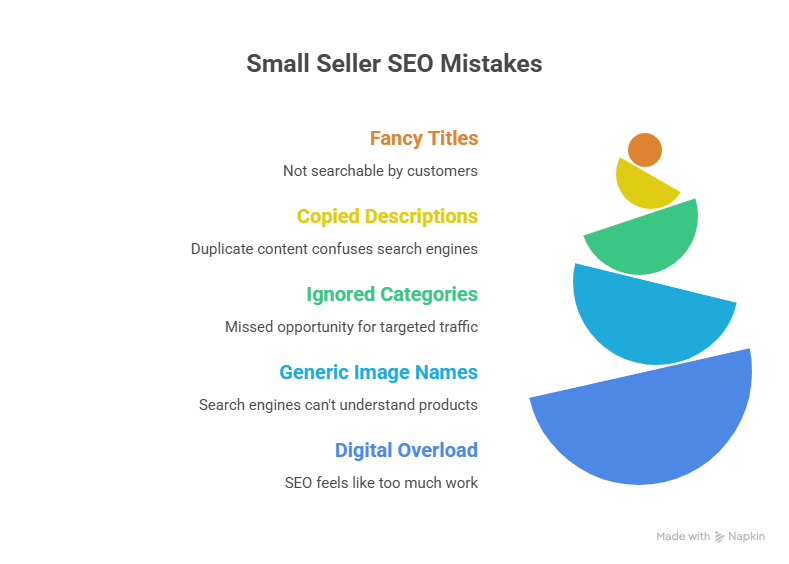
Common SEO mistakes small sellers make
Many small ecommerce businesses unknowingly make simple mistakes.
Some examples include:
Using fancy product titles instead of searchable ones.
Copying supplier descriptions.
Ignoring category pages.
Uploading images with names like IMG1234.
Instead, rename images properly.
For example:
cotton-bedsheet-king-size.jpg
This helps search engines understand the product.
Another common problem is digital overload.
Small sellers already manage inventory, packaging, courier partners, and customer complaints.
Learning SEO feels like one more complicated task.
The key is to focus on a few improvements consistently.
A practical SEO routine for small ecommerce stores
If you run a small ecommerce website, this simple routine works well. The goal is not only to bring traffic but also to improve your conversion rate, meaning more visitors actually become customers.
First, identify keywords using Google suggestions. This helps your products appear when people search for them online.
Second, improve product titles using clear product names and important features so visitors immediately understand what you are selling.
Third, write helpful product descriptions that answer customer questions and build trust. Clear descriptions often increase the conversion rate because buyers feel more confident about purchasing.
Fourth, add short introductions to category pages so search engines and customers both understand what products the section contains.
Finally, ensure your website loads quickly and works smoothly on mobile devices. A fast, easy-to-use store can significantly improve your conversion rate since visitors are less likely to leave before completing their purchase.
These steps gradually build a strong ecommerce SEO strategy while also helping turn more visitors into paying customers.
Conclusion
For many sellers, SEO initially feels technical.
But in reality, SEO for ecommerce is mostly about clarity.
Product page optimization tips that increase sales
If you run an online store in India today, your product page is your salesperson. Customers cannot touch the product, ask questions in person, or see it physically. Everything they need to decide must come from that single page.
In 2026, this matters even more because ecommerce competition in India is growing rapidly. According to the Bain & Company India ecommerce report, the Indian online retail market has reached around $60 billion with more than 270 million online shoppers.
With thousands of sellers offering similar products, small improvements to your product page can make a huge difference.
For example, ecommerce stores typically see conversion rates around 2–3%, while well-optimized product pages can exceed 5%.
This means improving your product page can almost double your sales without increasing traffic.
Let us look at practical product page optimization tips that Indian ecommerce sellers can implement immediately.
Practical product page optimization tips
Use better product images
Images are the first thing customers notice. If your product images look unclear or unprofessional, many buyers will leave the page immediately.
Research shows that high-quality product images reduce return rates and increase purchase confidence.
What you should do
Upload at least 5 to 6 product images:
Front view
Side view
Close-up of product details
Product in real-life usage
Size comparison image
Packaging image
Customers want to clearly understand what they are buying.
Improve images using free AI tools
If your images look basic, you can improve them using AI tools.
Free tools you can try:
Canva AI background remover
Remove.bg
Adobe Express AI
You can also use ChatGPT or Gemini to generate image improvement prompts.
Example prompt:
Improve this ecommerce product image. Enhance lighting, remove shadows, sharpen the product edges, and create a clean white background suitable for an online store.
Reduce image file size
Large images slow down your page.
Aim for image size under 200 KB per image.
Free tools to compress images:
Search on Google: “image compressor free tool”
Popular options:
TinyPNG
Squoosh
ImageCompressor
Upload the image and compress it before adding it to your website.
Write product descriptions that focus on benefits
Many sellers make a mistake here. They only describe product features.
Customers care about benefits, not just specifications.
“Stay hydrated all day with this leak-proof stainless steel bottle designed for office, gym, and travel. Double insulation keeps drinks cold for hours.”
See the difference? The second description explains the benefit.
Simple structure for writing descriptions
Use this format:
Problem → Solution → Benefit
Example:
Problem Most bottles leak inside bags.
Solution Our bottle uses a double-seal cap.
Benefit Your bag stays dry and your drink stays cold.
Use AI to generate descriptions
You can use ChatGPT or Gemini to quickly generate better descriptions.
Prompt example:
Write a 120-word ecommerce product description for a stainless steel water bottle. Focus on benefits, daily use, and customer problems. Keep language simple and persuasive.
Another useful prompt:
Generate 5 bullet points highlighting the benefits of this product for an ecommerce product page.
AI tools save time and help you write stronger descriptions.
Add real customer reviews and ratings
Reviews build trust. Most online shoppers read reviews before buying.
Research shows that over 95% of customers check reviews before purchasing online.
What you should do
Encourage customers to leave reviews.
Ways to collect reviews:
Send a WhatsApp message after delivery
Offer a small discount coupon for a review
Ask for photo reviews
Example message you can send:
“Thank you for your purchase! If you liked the product, please share a quick review and photo. It helps small businesses like us.”
Display reviews correctly
Do not hide reviews at the bottom.
Place them:
near the product title
below the description
near the “Buy Now” button
Even 10 real reviews can significantly increase trust.
Improve page loading speed
Slow product pages reduce conversions.
If a page takes too long to load, customers simply leave.
Aim for a page loading time under 2 seconds.
What you should do
Compress product images
Avoid heavy video files
Use lightweight website themes
Remove unnecessary plugins
Free tools to test page speed
Use these free tools:
Google PageSpeed Insights GTmetrix
Simply paste your product page link and the tool will show speed issues.
Follow the suggestions to improve performance.
Add trust signals to your product page
Many customers hesitate because they are unsure whether the store is reliable.
Trust signals help reduce this hesitation.
Add these elements
Cash on Delivery badge
Free shipping message
Return policy
Secure payment icons
Warranty information
Example trust messages:
“7-day easy returns” “Secure payment with Razorpay” “Trusted by 5,000+ customers”
These small signals make customers feel safer when buying.
Use a strong call-to-action button
The call-to-action button tells customers what to do next.
Examples:
Buy Now Add to Cart Order Today
Make the button effective
Your button should be:
large
clearly visible
in a contrasting colour
Example:
If your website background is white, use orange or green buttons.
Also place the button above the fold, meaning customers should see it without scrolling.
You can also add urgency.
Example text:
“Limited stock available”
Urgency encourages quicker decisions.
Optimise product pages for mobile users
Most ecommerce traffic in India now comes from smartphones.
However, mobile users convert less if the page is difficult to read.
What you should do
Use large product images
Avoid long paragraphs
Use bullet points
Make buttons large and clickable
Check your product page on your own phone.
If it feels difficult to navigate, customers will feel the same.
Use AI tools to improve product SEO
Search engine optimisation helps customers find your product through Google.
You can use ChatGPT or Gemini to generate SEO-friendly titles and descriptions.
Prompt example:
Generate an SEO product title and meta description for an ecommerce product page selling a stainless steel water bottle in India. Focus on keywords and benefits.
Another prompt:
Suggest SEO keywords that customers in India might search when buying a stainless steel water bottle online.
AI tools help improve visibility without needing advanced SEO knowledge.
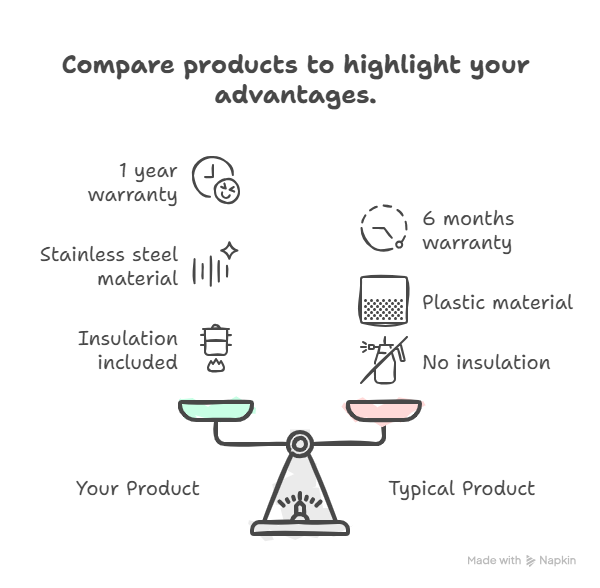
Add comparison tables
Customers often compare products before making a decision.
A comparison table helps customers quickly understand why your product is better.
Example:
This format makes it easy for customers to see the advantage.
Test improvements regularly
Successful ecommerce businesses constantly test improvements.
This is called A/B testing.
You can test:
different product images
different headlines
different price displays
Even small changes can increase conversion rates.
For example:
Version A “Buy Now”
Version B “Order Today – Free Delivery”
Test both versions and see which performs better.
Simple checklist for product page optimization
Before publishing your product page, check this list.
✔ 5–6 high-quality images ✔ image size under 200 KB ✔ benefit-focused product description ✔ visible customer reviews ✔ page load time under 2 seconds ✔ trust badges displayed ✔ strong call-to-action button ✔ mobile friendly layout
If your page meets these points, it is already better than many ecommerce product pages.
Conclusion
In India’s fast-growing online market, traffic alone does not guarantee sales. What truly matters is how effectively your product page converts visitors into buyers.
Across most online stores, the average conversion rate is around 2–3 percent. This means that out of 100 visitors, only two or three may actually place an order. Because of this, even small improvements can make a big difference to revenue.
By improving product images, writing benefit-focused descriptions, adding real customer reviews, optimising page speed, and using simple AI tools like ChatGPT or Gemini to refine your content, small businesses can build product pages that compete with much larger brands.
This is also where SEO for ecommerce plays an important role. When your product pages are clear, helpful, and properly optimised for search engines, they not only attract more visitors but also make it easier for those visitors to trust your store and complete a purchase.
Remember, your product page is not just a place to display information. It acts as your digital salesperson.
When done right, it works 24/7 — bringing traffic through seo for ecommerce and turning visitors into paying customers.
References
Bain & Company – India ecommerce market report Invesp ecommerce conversion rate research Google PageSpeed Insights documentation Price2Spy ecommerce product page research Shopify ecommerce conversion best practices
Starting an online store in India today is easier than ever. Platforms, logistics, and payment systems allow even small sellers in tier 2 and tier 3 cities to start selling quickly.
But there is one challenge that many new entrepreneurs underestimate: building trust.
Customers do not just buy products. They buy from brands they believe in. When buyers see similar products from multiple sellers, they often choose the one that feels more relatable or trustworthy.
This is where a brand story becomes powerful.
A brand story explains why your business exists, what problem you solve, and why customers should trust your brand. When done well, it creates an emotional connection between the brand and its audience.
In 2026, when ecommerce competition in India is growing rapidly, a clear and authentic brand story can make your store stand out.
Why brand storytelling matters in India today
India’s ecommerce ecosystem has expanded significantly. According to Bain & Company’s India ecommerce report, the market reached around $60 billion with more than 270 million online shoppers.
This growth means more opportunity—but also more competition.
When customers see five sellers offering similar products, they often choose the brand that:
feels trustworthy
feels authentic
explains its purpose clearly
A well-crafted brand story helps achieve exactly that.
Brand storytelling builds emotional connection with customers and makes your brand easier to remember compared to simple advertising.
What a brand story actually is
A brand story is not just an “about us” paragraph.
It is the narrative that explains:
why your business started
what problem you want to solve
what values your brand believes in
how customers benefit from your work
A strong story helps customers understand the journey behind the brand and the people who built it.
The simple framework to build your brand story
The best brand stories follow a simple structure. Think of it like a short story with a beginning, problem, and solution.
1. Start with the problem
Every strong brand begins with a problem.
Ask yourself:
What frustration made you start this business?
Examples:
difficulty finding affordable skincare
poor quality electronics accessories
lack of eco-friendly household products
Customers should see their own problems reflected in the story.
2. Show how the idea started
Next, explain how the idea for my brand started.
You might mention:
when the idea came
what inspired the product
what challenges you faced
People enjoy stories about real journeys.
Even small struggles make the story relatable.
3. Make the customer the hero
One important insight from modern storytelling frameworks is this:
Your customer should be the hero of the story, not your brand.
Your brand simply helps them solve their problem.
For example:
Instead of saying
“Our brand makes the best backpacks.”
Say
“We designed these backpacks to help students carry heavy books comfortably.”
This subtle shift makes the story more customer-focused.
4. Explain what makes your brand different
Customers also want to know why your brand exists when similar products already exist.
You should explain:
better quality
better pricing
local sourcing
sustainable production
This is the part where building a story brand becomes powerful.
It helps customers understand your unique value.
5. Show the mission behind your brand
Finally, share the impact your brand wants to create.
For example:
supporting local artisans
making healthy products affordable
promoting sustainable lifestyles
Purpose makes brands memorable.
A simple template you can follow
If writing a brand story feels difficult, use this template.
My brand started because I noticed a problem where people struggled with ______.
I decided to create a solution by building a product that helps ______.
What makes our brand different is _______.
Our mission is to _______.
This simple structure works for most small businesses.
Brand story examples for Indian businesses
Several Indian brands have successfully used storytelling.
For example:
Paper Boat built its brand around nostalgic Indian childhood drinks.
Mamaearth focuses on toxin-free personal care and transparent ingredients.
boAt connects with young customers through music and lifestyle culture.
These brands use storytelling to create emotional connection with customers.
Where to place your brand story on your online store
A brand story should appear in multiple places.
About page
Your “about us” page should contain the full story.
Customers often visit this page before trusting a new brand.
Product pages
You can include small parts of the story in product descriptions.
Example:
Explain how the product was designed.
Social media
Share behind-the-scenes content, founder journeys, and customer experiences.
This strengthens the connection between your personal brand and the business.
Common mistakes when building a brand story
Many small businesses make these mistakes.
Talking only about the product
Customers care more about how the product helps them.
Writing a long corporate story
Simple and relatable stories work better.
Making exaggerated claims
Authenticity builds trust.
A quick exercise to build your story today
Take five minutes and answer these questions.
Why did I start this business?
What problem does my product solve?
What makes my brand different?
What impact do I want my brand to create?
Your answers can become the foundation of your brand story.
Why storytelling increases conversions
A good brand story helps customers:
trust your business
remember your brand
feel connected to your mission
Stories create emotional connection and make brands more memorable than simple product advertising. When combined with strong product page optimization, storytelling can significantly improve conversion rates.
That emotional connection often influences purchasing decisions.
Conclusion
In India’s growing ecommerce ecosystem, products alone are rarely enough to stand out.
Customers want to know who they are buying from and why the brand exists.
A clear brand story explains your purpose, connects with customer problems, and shows the values behind your business.
For small businesses launching online stores in 2026, storytelling is not just marketing. It is one of the most effective ways to build trust, create identity, and turn visitors into loyal customers.
References
Semrush brand storytelling guide FlippingBook brand story marketing guide Bain & Company India ecommerce report Headstream storytelling research India Brand Equity Foundation ecommerce insights
By 2026, the way Indians buy and sell products has changed even more rapidly. Social ecommerce has now become a major part of everyday business, especially for small sellers, home entrepreneurs, and young people looking for flexible income options. Families in tier 2 and tier 3 cities continue to spend a large part of their day on social platforms, whether they are watching short videos, comparing products, or chatting with neighbourhood sellers. Because of this natural digital habit, social ecommerce has become one of the easiest and most trusted ways to start selling online without needing heavy investment or advanced technical skills.
A report from Meta and Bain & Company in 2023 found that more than 60 percent of Indian shoppers discover new products online through social media. Even in 2026, this behaviour remains strong. Product discovery through reels, short videos, and creator recommendations is now a daily part of online shopping. For small business owners, this means a higher chance of being discovered by the right customers without huge marketing budgets.
What is social ecommerce?
Social ecommerce is the practice of buying and selling products directly through social media platforms. In 2026, platforms like Facebook, Instagram, and even newer short video apps allow sellers to showcase products, chat with customers, and close sales in one place. The entire journey from browsing to buying happens inside the app, which feels very natural for people in smaller cities who prefer familiar and simple buying experiences.
It is also closely linked to social media ecommerce and social selling, both of which involve building trust, having friendly conversations, and sharing real product experiences. Many sellers begin with simple photos or reels, and as they grow, they turn their collections into proper online stores using easy tools that do not require technical knowledge.
Why social ecommerce is booming in tier 2 and tier 3 cities?
In 2026, India’s smaller cities are driving the next wave of digital buying. People prefer communication that feels personal and real, which is why social ecommerce works so well. It allows customers to ask questions directly, see live videos of products, and get quick responses.
Several everyday situations continue to support this trend:
working parents who rely on quick product suggestions during breaks
students who explore affordable fashion through local influencers
homemakers running small online stores from home
young sellers experimenting with handmade items or curated products
According to a 2022 study by kpmg, nearly half of india’s new online shoppers come from tier 2 and tier 3 cities. Even in 2026, this shift is still growing, with more people preferring trusted digital spaces over traditional websites. Social ecommerce gives them a familiar, comfortable way to shop with confidence.
How online stores are becoming easier to create?
Until a few years ago, the idea of creating an online store felt overwhelming. Today in 2026, it is simpler than ever. Anyone can set up an online store using guided tools, or they can hire professionals for a cleaner and more organised design. Both choices work well because platforms now focus on ease and affordability.
Platforms like wcommmer.store make the process smooth for everyday sellers. For example, Ankur Barjatiya from MP already runs his store, where the products are ready to sell without any inventory burden. He simply promotes them on instagram, the orders come in, and wcommmer.store handles the packing and delivery. This setup saves him time and allows him to focus on engaging with customers and growing his reach.
The human side of social ecommerce
The biggest strength of social ecommerce in 2026 is still its personal touch. A shop owner can talk directly with customers, show real videos, clear doubts instantly, and build natural relationships. This is especially meaningful in indian communities where every purchase involves trust.
When buyers see genuine reviews, unfiltered photos, or recommendations from local influencers they relate to, it increases social proof and builds confidence. This is why community-driven shopping is becoming such a powerful trend. People feel more comfortable buying when they know the seller or when the product is suggested by someone whose lifestyle feels familiar.
What sellers can realistically expect?
Even in 2026, social ecommerce remains a practical and achievable way to start a business. It does not promise overnight success, but it provides a strong foundation for steady growth.
Here is what sellers can realistically expect:
a low cost and low risk way to start
direct conversations with buyers
easy testing of new products
useful feedback for improvement
long term trust through consistent engagement
Many small sellers continue to start with homemade goods, thrift fashion, beauty essentials, or home decor items. Over time, they understand customer preferences and slowly improve their online stores. Even a single well presented product can go viral on social media and create steady demand.
Common questions people ask about social ecommerce
Is it safe to buy and sell through social platforms?
Yes, it is generally safe when sellers follow basic practices such as clear product details, transparent prices, and secure payment options. Buyers should also check reviews and ask questions before confirming orders.
Do i need to be good at technology?
Not at all. Most platforms in 2026 are designed for beginners. Posting a product, replying to messages, and updating prices are enough to get started. Sellers can learn other features slowly at their own pace.
Can social ecommerce become a stable income source?
Yes, but stability requires consistency. Sellers who stay active, create fresh content, and maintain product quality usually see steady improvement in sales.
Conclusion
By 2026, social ecommerce has become a powerful opportunity for small sellers and individuals across India, especially in tier 2 and tier 3 cities. With familiar platforms, simple tools, and direct communication, anyone can create an online store and start selling without complex setups. Whether someone starts on their own or takes help from a professional, the path is practical and achievable. If you are planning to begin, start with one simple product, listen to your customers, and allow your business to grow steadily. Social ecommerce is not just a trend in 2026 — it is a dependable way to build income in India’s evolving digital landscape.
How to start an online business in India with zero investment
Starting a business online without money may sound like a daunting task, but thanks to the digital revolution, it's more achievable than ever. With a bit of creativity and a lot of dedication, it's possible to set up an ecommerce store with zero to minimal investment. In this guide, I will show you the best online business to start without spending a fortune. Let's dive into how you can begin your journey in ecommerce, the tools you'll need, and the strategies you can employ to succeed without investing heavily.
Why Ecommerce?
Ecommerce is a booming industry with tremendous growth potential. In India alone, the ecommerce market is expected to reach $200 billion by 2026 (source: IBEF, 2020). This rapid growth is driven by increasing smartphone penetration and improved online payment experiences. For beginners, ecommerce presents an opportunity to reach a vast customer base without the expense and risk associated with a physical storefront.
How Can I Start Online Business Without Investment?
Starting an online business without investment primarily involves utilizing free tools and resources available online. Here’s a brief overview:
Free Online Store Tools
Wix: Known for its user-friendly interface, Wix allows you to create a website without coding. With its free plan, you can set up a basic online store in no time.
Odoo: An open-source ERP with a comprehensive suite of business applications. Odoo’s free plan offers essential ecommerce features that enable you to start an online store without any upfront cost.
Wcommerce: A popular onine platfrom that 25000+ people are already using to create their online ecommerce store for free and sell 600+ products without any inventory.
Simple E-commerce Builder
A simple e-commerce builder is essential for beginners. These platforms often offer drag-and-drop functionalities, meaning you don’t need to be a tech expert to design a professional-looking store. With tools like Wix and WooCommerce, you can efficiently create a stunning site that rivals any high-budget store.
Zero-Budget Digital Marketing
Once your store is live, focus on zero-budget digital marketing strategies to attract customers:
Social Media Marketing: Use social media platforms like Instagram, Facebook, and Twitter to promote your products for free. Engage your audience with regular updates, engaging stories, and customer testimonials.
Content Marketing: Start a blog related to your products. This helps with SEO and establishes authority in your niche. Write insightful articles that answer potential customer questions – a great way to drive organic traffic.
Email Marketing: Build an email list from day one. Free tools like Mailchimp offer powerful features to connect with your audience without spending a dime.
Don’t let a lack of coding skills stop you from starting your online business. Platforms like Shopify and Squarespace, along with the aforementioned Wix, offer comprehensive guides and templates. They simplify the process of building and running an ecommerce store. With these, creating a website without coding knowledge is not only possible, but practical. But currently there are many platfroms in the market like Wcommerce that allows to directly open a ecommerce store without creating any website. They provide a built-in ecommerce store when you create a store there.
Case Study: A Real Example
Consider the inspiring story of someone who started their business with zero investment. Rinku, an entrepreneur from a rural village in Odisha, is now earning daily with constant orders coming through his online store. By using free tools like Wcommerce to create his store and selling 600+ products without keeping any inventory, along with social media and local marketing, Rinku is scaling his business every day. He only focuses on promotion because packing and delivery are taken care of by the platform.
Conclusion: Best Online Business to Start
In conclusion, the best online business to start if you're under budget constraints is undoubtedly in the ecommerce sector. With the wealth of free online store tools, no-cost ecommerce setup options, and the ability to create a website without coding, starting an online business has never been more accessible. Remember, dedication and creativity can turn your zero-investment business into a profitable venture. Start small, leverage free tools, and build your empire.
India's e-commerce industry is experiencing unprecedented growth, transforming the way people shop and do business. With a rapidly increasing internet user base, affordable smartphones, and widespread digital payment adoption, the e-commerce sector is booming. Reports suggest that India's e-commerce market will surpass $200 billion by 2027, making it one of the fastest-growing markets globally.
Choosing the right e-commerce platform is crucial for entrepreneurs looking to start an online business. The right platform determines ease of setup, scalability, marketing options, and overall profitability. Whether you’re a small business owner, a solopreneur, or a dropshipper, selecting a platform that aligns with your goals can make or break your success in the digital marketplace.
Several factors are fueling the rapid expansion of e-commerce in India, including:
Growing Internet Penetration – With over 900 million internet users, online shopping is more accessible than ever.
Rise of Digital Payments – UPI, wallets, and card payments have simplified transactions, increasing consumer trust.
Mobile Commerce (m-commerce) – More than 80% of shoppers browse and buy via smartphones.
Government Initiatives – Programs like Digital India and FDI relaxations in e-commerce have encouraged growth.
Changing Consumer Behavior – The demand for convenience, variety, and fast delivery continues to drive online purchases.
With these factors shaping the e-commerce landscape, it's an exciting time for aspiring entrepreneurs to leverage online platforms and build successful businesses.
Key features of a good e-commerce platform
Choosing the right e-commerce platform is essential for a smooth and successful online business. Here are the key features to consider:
User-friendly interface and easy setup – the platform should be simple to use, allowing quick store setup without technical expertise.
Payment gateway integration and security – secure payment options like UPI, credit and debit cards, and digital wallets ensure safe transactions and customer trust.
Mobile responsiveness and app support – since most customers shop on their phones, the platform must be mobile-friendly and support app integration.
Scalability for business growth – as your business grows, the platform should handle increased traffic, more products, and advanced features without performance issues.
Customer support and analytics tools – 24/7 support and built-in analytics help track sales, customer behavior, and marketing performance, enabling better decision-making.
Types of e-commerce platforms
E-commerce platforms can be categorized into three main types, each offering unique advantages depending on business needs.
Market place-based platforms – these platforms allow third-party sellers to list their products on an established website, giving them instant access to a large customer base. Examples include amazon, flipkart, and meesho. They handle website maintenance, customer trust, and payment security, making it easier for sellers to focus on product sourcing and fulfillment. However, these platforms charge commissions on sales and impose strict policies, which may limit a seller's control over pricing and branding.
Self-hosted platforms – business owners create their own online store with full control over branding, pricing, and marketing. Platforms like shopify, woocommerce, and bigcommerce allow sellers to design a personalized store, choose their preferred payment gateways, and implement marketing strategies without restrictions. While self-hosted platforms offer greater independence, they require effort in terms of website setup, maintenance, and driving traffic through SEO, social media, or paid ads. These platforms are best suited for businesses that aim for long-term growth and scalability.
Social commerce platforms – businesses sell directly through social media and messaging apps like instagram, facebook marketplace, whatsapp business, and Wcommerce. These platforms make it easy for entrepreneurs to reach potential buyers through direct engagement, influencer marketing, and organic content. Unlike traditional online stores, social commerce allows businesses to communicate with customers in real time, providing a more personalized shopping experience. It is an excellent option for small businesses, home-based sellers, and startups with limited budgets who want to sell without investing in a dedicated website.
Each type of platform has its own benefits and challenges. Choosing the right one depends on factors such as business goals, target audience, and available resources.
E-commerce and dropshipping: a profitable partnership
E-commerce has revolutionized the way businesses operate, allowing entrepreneurs to sell products online with minimal investment. One of the most effective business models within e-commerce is dropshipping, which enables sellers to operate without holding inventory. By leveraging e-commerce platforms, dropshipping has become a scalable and low-risk way to start an online business.
What is dropshipping and how it works?
Dropshipping is a fulfillment method where sellers list products on their online store without stocking them. When a customer places an order, the seller purchases the product from a third-party supplier, who ships it directly to the customer. This eliminates the need for warehousing, making it an attractive option for new entrepreneurs. The process works as follows:
The seller lists products on their e-commerce platform.
A customer places an order and makes payment.
The seller forwards the order details to the supplier.
The supplier ships the product directly to the customer.
The seller earns a profit from the price markup.
How e-commerce platforms support dropshipping businesses?
E-commerce platforms play a crucial role in supporting dropshipping businesses by providing tools for store management, payment processing, and supplier integration. Platforms like shopify, woocommerce, and Wcommerce offer plugins that connect sellers with suppliers from aliexpress, cj dropshipping, and zendrop, enabling automated product imports and order fulfillment. These platforms also provide SEO, marketing, and analyticstools to help sellers optimize sales and grow their business.
Benefits of dropshipping in e-commerce
Dropshipping is one of the most accessible ways to enter e-commerce due to its:
Low startup cost – no need to invest in inventory or storage.
No inventory management – suppliers handle stocking and shipping, reducing operational workload.
Wide product variety – sellers can offer a vast range of products without storage limitations.
Scalability – business owners can experiment with different niches and expand their business without significant upfront costs.
How Indian entrepreneurs are using dropshipping to scale businesses
Dropshipping is gaining momentum in India as more entrepreneurs leverage e-commerce platforms to sell both domestically and internationally. With the increasing adoption of digital payments, social commerce, and supplier networks, platforms like meesho and Wcommerce are enabling small businesses and individuals to start selling without investment. Many Indian entrepreneurs are also using Instagram and WhatsApp Business to market their products and drive traffic to their online stores.
Challenges of dropshipping and how to overcome them
While dropshipping simplifies e-commerce, it comes with challenges:
Longer shipping times – international suppliers may take weeks to deliver. : Solution - work with local suppliers for faster delivery.
Lower profit margins – intense competition can reduce profits. : Solution - choose niche products and offer value-added services.
Supplier reliability issues – inconsistent stock and product quality can affect business : Solution - partner with multiple reliable suppliers and test products before listing.
Customer service challenges – handling returns and complaints can be difficult. : Solution - set clear refund policies and provide proactive customer support.
Despite these challenges, dropshipping remains one of the easiest and most cost-effective ways to start an e-commerce business. With the right platform and strategy, entrepreneurs can build a successful online store and scale it over time.
Direct selling in the digital era: e-commerce as a game changer
The rise of e-commerce has transformed the way businesses operate, and direct selling is no exception. Traditionally reliant on face-to-face interactions and personal networks, direct selling has now expanded into the digital space, allowing sellers to reach a global audience with ease. E-commerce platforms have become a game changer, making direct selling more efficient, scalable, and accessible than ever before.
How direct selling differs from traditional e-commerce
While both direct selling and traditional e-commerce involve online transactions, they operate differently:
Direct selling focuses on person-to-person sales, often through independent distributors who promote products within their networks. It thrives on relationships, referrals, and community-driven marketing.
Traditional e-commerce involves selling products through online marketplaces or self-hosted stores, where customers browse and purchase independently without personal interaction.
Direct selling leverages the trust factor of personal recommendations, whereas e-commerce relies more on product listings, reviews, and digital advertising to drive sales.
Role of e-commerce in expanding direct selling businesses
E-commerce has significantly enhanced direct sellingby providing:
Online storefronts – sellers can create their own branded stores, reducing dependence on physical inventory.
Digital payment systems – secure and instant transactions through UPI, credit cards, and wallets simplify sales.
Social media integration – platforms like instagram, facebook marketplace, whatsapp business, and Wcommerce help seller’s market and sell directly to customers.
Logistics and fulfillment solutions – partnerships with delivery services streamline order processing and shipping.
By combining direct selling with e-commerce tools, businesses can scale faster and operate more efficiently.
How online stores and digital platforms are reshaping direct selling
With the shift towards online shopping, direct sellers are increasingly using digital platforms to reach more customers.
Self-hosted e-commerce websites (such as shopify, woocommerce, and Wcommerce) allow direct sellers to build their own branded stores.
Marketplace platforms like amazon and meesho provide access to an established customer base.
Social commerce platforms enable direct sellers to leverage live selling, influencer marketing, and chat-based transactions for a personalized shopping experience.
This shift allows direct sellers to expand their reach beyond local communities, tapping into national and even global markets.
Benefits of using e-commerce tools for direct selling
Integrating e-commerce into direct selling offers several advantages:
Automation – order management, payments, and customer interactions can be automated, reducing manual workload.
Wider reach – sellers are no longer limited to in-person interactions and can market to a broader audience.
Better customer engagement – social media, email marketing, and chatbots help build stronger relationships with customers.
Data-driven decision-making – analytics tools provide insights into customer preferences and sales trends, enabling smarter business strategies.
These benefits make e-commerce an essential tool for modern direct sellers looking to grow their business.
Examples of how direct sellers are leveraging digital platforms
Many direct sellers have successfully embraced e-commerce:
Beauty and wellness entrepreneurs use Wcommerce and whatsapp business to sell skincare and health products directly to customers.
Fashion and accessory sellers leverage instagram shops and facebook marketplace for real-time engagement and sales.
Network marketing businesses use e-commerce tools to manage distributor networks and automate product deliveries.
By integrating digital platforms into their business models, direct sellers are adapting to the digital era and maximizing their growth potential.
How e-commerce is reshaping multi-level marketing
The digital revolution has transformed many industries, and multi-level marketing (MLM) is no exception. Traditionally, MLM relied on in-person networking, home parties, and direct sales. However, with the rise of e-commerce, MLM businesses have evolved into scalable, tech-driven models that allow distributors to reach wider audiences with greater efficiency.
How multi-level marketing (MLM) integrates with e-commerce
MLM companies are increasingly using e-commerce platforms to streamline operations and expand their reach. Instead of relying solely on in-person sales, distributors can now:
Set up personalized online stores to sell products directly to customers.
Use dropshipping models, where the company handles inventory and shipping while distributors focus on sales and recruitment.
Leverage social commerce platforms like Wcommerce, Instagram Shops, and Facebook Marketplace to market and sell products seamlessly.
Automate order processing, tracking, and commissions, making business management more efficient.
This integration allows MLM distributors to work smarter, not harder, reducing logistical challenges and enhancing customer experience.
Benefits of e-commerce for MLM companies and distributors
E-commerce brings multiple advantages to MLM businesses, including:
Wider reach – distributors can sell products beyond their local network, reaching customers nationally and globally.
Lower operational costs – companies save on warehousing and physical store expenses by shifting sales online.
Convenience – customers can browse and purchase products anytime, leading to higher sales conversions.
Real-time analytics – sellers can track sales performance, customer behavior, and marketing effectiveness through digital tools.
These benefits make MLM more adaptable to modern consumer trends, increasing business longevity and success.
How e-commerce is making MLM more scalable and accessible
Traditionally, MLM businesses faced challenges in scaling due to the limitations of in-person interactions. With e-commerce, scalability is easier than ever:
Automated processes reduce manual workload, allowing distributors to focus on growth strategies.
Self-replicating websites enable new distributors to quickly set up their online store without technical expertise.
Mobile-friendly platforms make it simple for distributors to manage their business from anywhere.
By eliminating geographical and operational barriers, e-commerce makes MLM more accessible to aspiring entrepreneurs.
Role of digital marketing, automation, and social commerce in MLM success
Modern MLM success depends on leveraging digital marketing, automation, and social selling:
Social media marketing – influencers, brand ambassadors, and direct sellers use Instagram, YouTube, and Facebook Groups to promote products.
Content marketing – educational blogs, live demos, and customer testimonials build credibility and attract potential buyers.
Email and chatbot automation – AI-powered chatbots handle inquiries, while automated emails nurture leads and boost conversions.
Affiliate and referral programs – E-commerce platforms support MLM structures by tracking referrals and commission payouts efficiently.
By integrating these tools, MLM businesses can scale faster and create long-term customer relationships.
Examples of MLM companies utilizing e-commerce platforms effectively
Many MLM companies have successfully embraced e-commerce to modernize their operations:
Amway and Herbalife provide distributors with personalized e-commerce websites for direct sales.
Oriflame and Avon leverage social commerce platforms and influencer marketing to reach digital audiences.
WCommerce enables independent sellers to set up free online stores and sell MLM products without upfront investment.
Forever living integrates automated tracking and commission management to enhance distributor earnings.
By combining MLM with e-commerce, companies and distributors are maximizing their earning potential while offering customers a seamless shopping experience.
Factors to consider when choosing an e-commerce platform
Selecting the right e-commerce platform is crucial for business success. Entrepreneurs should evaluate platforms based on their features, pricing, and scalability to ensure they align with their business goals. Key factors to consider include:
Pricing and affordability for small businesses – Platforms should offer cost-effective plans that suit startups and small enterprises without high upfront investments.
Customization and branding flexibility – A good platform allows businesses to create a unique store identity with customizable themes, layouts, and branding options.
Logistics and shipping integrations – Seamless partnerships with delivery services enable hassle-free order fulfillment and tracking.
SEO and digital marketing capabilities – Built-in tools for search engine optimization (SEO), social media marketing, and email campaigns help in customer acquisition.
Multi-channel selling – The ability to sell across different platforms, including personal websites, social media, and online marketplaces, enhances sales opportunities.
Best E-Commerce Platforms in India
India's e-commerce industry is thriving, offering various platforms that cater to businesses of all sizes. Whether you're a small business, startup, or large enterprise, choosing the right platform is crucial. Here’s a look at some of the best e-commerce platforms in India, categorized based on their features and user needs.
1. Marketplace-based platforms
These platforms allow businesses to list and sell products on an existing marketplace without the need to build a separate website. They provide ready-made traffic, making it easier for sellers to find customers.
Best suited for: Small businesses, independent sellers, and those looking for a hassle-free selling experience.
Key features:
Easy product listing with minimal setup.
Access to a large customer base.
Built-in payment and logistics support.
Advertising options to boost visibility.
Examples:
Amazon India – One of the largest marketplaces, offering fulfillment services and vast customer reach.
Flipkart – A leading Indian marketplace with seller-friendly policies and logistics support.
Meesho – Focuses on small businesses and resellers, offering a social commerce-friendly model.
2. Self-hosted e-commerce platforms
These platforms provide businesses with complete control over their online store, allowing full customization and branding flexibility.
Best suited for: Startups, medium-sized businesses, and brands that want independence from marketplaces.
Key features:
Customizable website with design flexibility.
Direct customer interaction without marketplace commissions.
Integration with third-party payment gateways and logistics providers.
Scalability for business growth.
Examples:
Shopify – A globally recognized platform that enables businesses to build and manage their own store with ease.
WooCommerce – A WordPress-based plugin that allows full customization and is ideal for businesses familiar with website development.
WCommerce – A platform designed specifically for beauty and wellness businesses, allowing users to create free stores and sell products without investment.
3. Social commerce platforms
These platforms enable sellers to sell products directly through social media and messaging apps, making it easier to reach customers where they spend most of their time.
Best suited for: Small business owners, influencers, and resellers who rely on social networks for marketing.
Key features:
Direct sales through social media platforms.
Minimal or no upfront costs.
Simple setup with no need for a dedicated website.
Integration with messaging apps for customer communication.
Examples:
Facebook Marketplace – Allows businesses and individuals to list and sell products locally.
Instagram Shops – Provides a visually appealing storefront directly linked to Instagram profiles.
Meesho – Enables resellers to share and sell products via WhatsApp and Facebook.
4. Enterprise e-commerce platforms
These platforms are designed for large businesses with high-volume sales, offering advanced customization, automation, and scalability.
Best suited for: Large enterprises, established brands, and businesses requiring high-level integrations.
Key features:
Advanced data analytics and customer management.
Scalable infrastructure for handling high traffic and large inventories.
Customizable features with API integrations.
Multi-channel selling across different platforms.
Examples:
Magento (Adobe Commerce) – A powerful open-source platform with extensive customization options for enterprises.
BigCommerce – offers built-in SEO and analytics tools, making it ideal for scaling businesses.
SAP commerce cloud – Designed for large-scale businesses requiring automation and AI-driven solutions.
Choosing the right e-commerce platform
When selecting an e-commerce platform, consider factors such as:
1. Business size and budget. 2. Customization and branding needs. 3. Logistics and payment integration. 4. SEO and marketing tools. 5. Scalability for future growth.
Each platform has its strengths, so the right choice depends on your business model and long-term goals.
E-commerce trends shaping the industry
Thee-commerce industry is constantly evolving, driven by technological advancements and changing consumer behavior. Some of the key trends influencing the future of online shopping in India include:
Rise of mobile-first shopping experiences – With a majority of Indian consumers accessing the internet via smartphones, businesses are optimizing their websites and apps for mobile commerce.
Growth of social commerce and influencer marketing – Platforms like Instagram, Facebook, and WhatsApp are becoming major sales channels, with influencers playing a significant role in product recommendations.
AI-powered personalization and chatbots – Artificial intelligence helps brands provide personalized recommendations, automated customer support, and data-driven marketing strategies.
Digital payments and UPI-driven transactions – The rapid adoption of digital payment methods like UPI, wallets, and buy-now-pay-later (BNPL) services is making online shopping more seamless and secure.
Challenges in e-commerce and how to overcome them
Despite it's growth, e-commerce businesses in India face several challenges. Here’s how they can be tackled:
Handling competition in the crowded market – Brands need strong digital marketing strategies, unique product offerings, and exceptional customer service to stand out.
Customer trust and retention strategies – Building trust through transparent policies, secure transactions, and excellent post-sales service is key to retaining customers.
Managing logistics and timely deliveries – Partnering with reliable logistics providers and using AI-driven inventory management helps ensure smooth operations.
Cybersecurity and fraud prevention – Implementing secure payment gateways, encryption, and fraud detection systems protects customer data and prevents online scams.
Future of e-commerce in India
The Indian e-commerce market is set for exponential growth, with several emerging trends shaping its future:
Expansion of hyperlocal and quick commerce – Instant delivery services and hyperlocal shopping models are gaining traction, catering to consumers who want faster access to products.
Integration of AR/VR for a better shopping experience – Augmented reality (AR) and virtual reality (VR) allow customers to try products virtually, improving their shopping experience.
Growth of voice and vernacular commerce – With an increasing number of regional language users, voice search and vernacular content are becoming crucial for e-commerce platforms.
Role of AI, blockchain, and automation in e-commerce – AI-driven analytics, blockchain-based secure transactions, and automated order fulfillment will continue to revolutionize online retail.
Conclusion
The Indian e-commerce industry is experiencing rapid transformation, offering immense opportunities for businesses. Key takeaways include:
Choosing the right e-commerce platform based on business size, budget, and scalability needs.
Leveraging digital tools like AI, social commerce, and mobile-first strategies to stay competitive.
Overcoming challenges related to logistics, trust, and security through smart business strategies.
Adapting to future trends such as quick commerce, AR/VR, and voice commerce to stay ahead in the evolving market.
With the right approach, businesses can harness the full potential of e-commerce and build a sustainable online presence in India.
Frequently Asked Questions (FAQs) About E-Commerce in India
1. What is the best e-commerce platform for small businesses in India?
The best platform depends on your business needs, marketplace-based platforms like Amazon and Flipkart are great for reaching a large audience, while self-hosted platforms like Shopify, WooCommerce, and WCommerce allow full customization and brand control.
Dropshipping is relatively easy as it eliminates inventory management, but success depends on choosing the right niche, marketing strategies, and supplier reliability. Platforms like WCommerce and social commerce sites make it easier and profitable to start without investment.
4. How profitable is an e-commerce business in India?
E-commerce can be highly profitable if you:
Select a high-demand niche with good profit margins.
Use cost-effective marketing strategies like SEO, influencer collaborations and email marketing.
Optimize operations and logistics to reduce expenses.
Leverage multiple sales channels (website, marketplaces, social media) for maximum reach.
Create your store with Wcommerce today and enjoy a zero subscription fee forever. Don't miss this exclusive opportunity to maximize your earnings without any monthly costs.





.jpg)
.svg)
.avif)
.avif)

.avif)